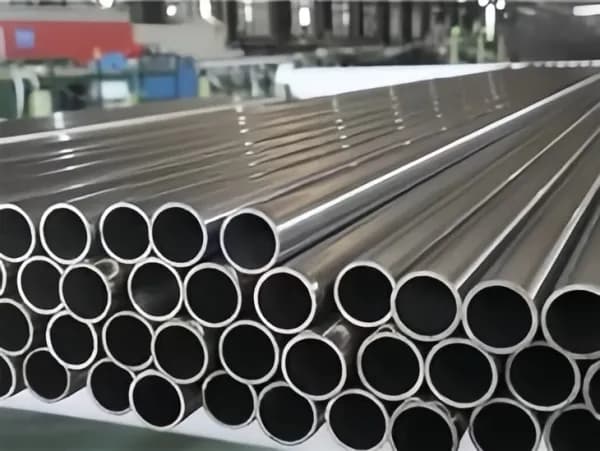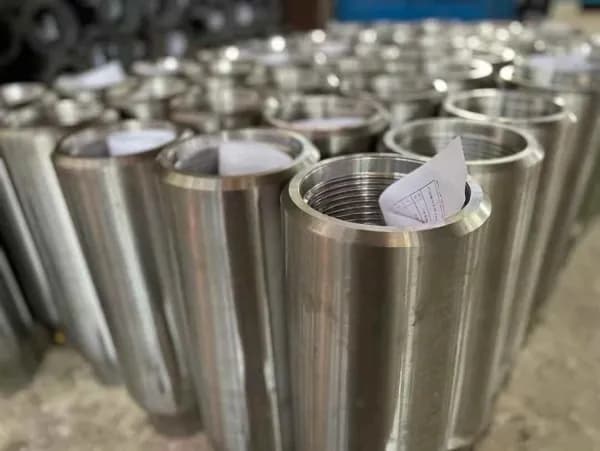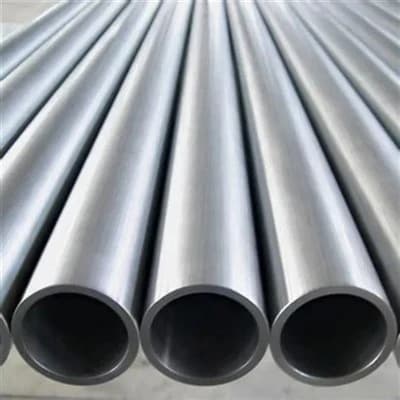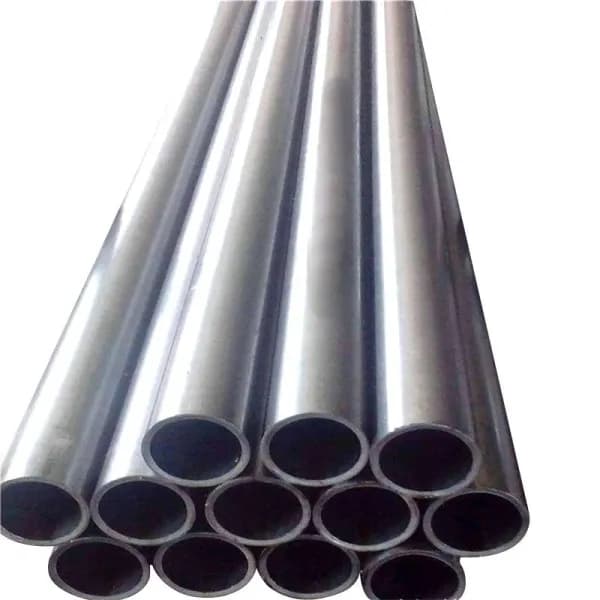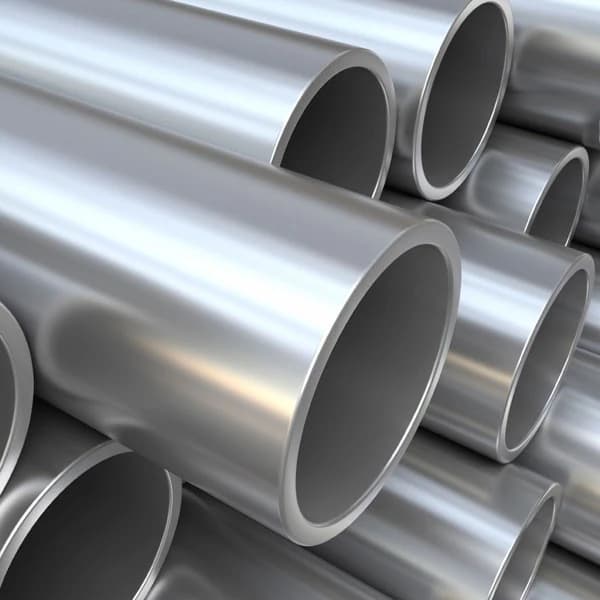
Titanium alloy pipe is ordered where corrosion resistance and weight matter more than raw material cost: seawater cooling lines, chloride-bearing chemical duty, desalination plant and high-purity process lines. This page covers commercially pure (CP) Grades 1-4 and the alloy grades most often supplied in pipe - Grade 5 (Ti-6Al-4V), Grade 7 (Ti-0.15Pd), Grade 9 (Ti-3Al-2.5V) and Grade 12 (Ti-0.3Mo-0.8Ni), plus the palladium- and ruthenium-bearing variants Grades 24, 26 and 29 - so the grade, the standard and the inspection level can be matched to the service before a quotation is requested.
Pipe Standards: ASTM B861, B862 and B338 Are Not Interchangeable
The three standards cover different products, and mixing them up is the most common specification error with this material: B861 is the seamless pipe standard, B862 is the welded pipe standard, and B338 covers tube for condensers and heat exchangers - not the other way round. The table below gives the actual scope of each.
| Standard | Product covered | Manufacturing route | Typical duty |
|---|---|---|---|
| ASTM B861 | Titanium and titanium-alloy pipe | Seamless | Process piping ordered by NPS or outside diameter and wall (or schedule) |
| ASTM B862 | Titanium and titanium-alloy pipe | Welded | Welded process pipe where the design permits the welded route, often at larger diameters |
| ASTM B338 | Titanium and titanium-alloy tube | Seamless or welded, as ordered | Surface condensers, evaporators and shell-and-tube heat exchangers, ordered as OD x wall |
| ASME SB861 / SB862 / SB338 | Same material, ASME-code editions | As above | Pressure-boundary work governed by the ASME code |
Companion stainless steel, nickel and alloy piping components are standardised separately: wrought fittings to ASTM B363 and flanges to ASTM B381, in matching grades.
Grades and Chemical Composition
The table lists the grades this page covers with their UNS numbers and principal alloying additions; limits for interstitial and residual elements follow the ordered edition of the standard.
| Grade | UNS | Composition | Positioning |
|---|---|---|---|
| Grade 1 | R50250 | CP titanium | Softest and most formable CP grade |
| Grade 2 | R50400 | CP titanium | The general-purpose CP grade for corrosion service |
| Grade 3 | R50550 | CP titanium | Higher-strength CP grade |
| Grade 4 | R50700 | CP titanium | Highest-strength CP grade |
| Grade 5 | R56400 | Ti-6Al-4V (Al 5.5-6.75 %, V 3.5-4.5 %) | High-strength alpha-beta alloy, the most widely used titanium alloy |
| Grade 7 | R52400 | CP titanium + 0.12-0.25 % Pd | Grade 2 chemistry with palladium for improved reducing-acid and crevice performance |
| Grade 9 | R56320 | Ti-3Al-2.5V (Al 2.5-3.5 %, V 2.0-3.0 %) | Stronger than CP grades, more formable than Grade 5; common in hydraulic and instrumentation lines |
| Grade 12 | R53400 | Ti-0.3Mo-0.8Ni (Mo 0.2-0.4 %, Ni 0.6-0.9 %) | Improved resistance to hot chloride media at near-CP cost |
| Grade 24 | R56405 | Ti-6Al-4V + 0.04-0.08 % Pd | Grade 5 variant for mildly reducing chloride duty |
| Grade 26 | R52404 | CP titanium + 0.08-0.14 % Ru | Ruthenium-bearing CP grade, an alternative to the palladium grades |
| Grade 29 | R56404 | Ti-6Al-4V ELI + 0.08-0.14 % Ru | Extra-low-interstitial Grade 5 variant with ruthenium |
Mechanical Properties (Minimum Values, Annealed)
The minima below are quoted from the seamless pipe standard ASTM B861, whose property tables the welded and tube standards share for the same grades; values apply to the annealed condition and the ordered edition governs.
| Grade | Tensile strength min | 0.2 % yield strength min | Elongation in 50 mm min |
|---|---|---|---|
| Grade 1 | 240 MPa (35 ksi) | 170 MPa (25 ksi) | 24 % |
| Grade 2 | 345 MPa (50 ksi) | 275 MPa (40 ksi) | 20 % |
| Grade 3 | 450 MPa (65 ksi) | 380 MPa (55 ksi) | 18 % |
| Grade 4 | 550 MPa (80 ksi) | 483 MPa (70 ksi) | 15 % |
| Grade 5 | 895 MPa (130 ksi) | 828 MPa (120 ksi) | 10 % |
| Grade 7 | 345 MPa (50 ksi) | 275 MPa (40 ksi) | 20 % |
| Grade 9 | 620 MPa (90 ksi) | 483 MPa (70 ksi) | 15 % |
| Grade 12 | 483 MPa (70 ksi) | 345 MPa (50 ksi) | 18 % |
Grades 24, 26 and 29 carry their own minima in the standard - they mirror Grade 5, Grade 2 and the extra-low-interstitial Grade 5 respectively, subject to edition detail - so the values invoked by the order govern. Densities are about 4.51 g/cm³ for the CP grades and about 4.43 g/cm³ for Grade 5, roughly half that of steel: that density difference, not a marketing slogan, is where the weight saving in a piping system actually comes from.
Corrosion Resistance and Service Limits
Titanium's corrosion resistance comes from a stable, self-repairing oxide film, and the practical limits are as important as the strengths.
These grades perform strongly in seawater, brines and chloride-bearing media, in oxidizing acids such as nitric acid, and in wet chlorine service - which is why chemical processing, desalination and marine piping dominate the order book. The film's weak points are strongly reducing acids (hydrochloric and sulfuric acid without oxidizing agents present) and crevice conditions in hot seawater; the palladium-bearing Grade 7 and Grade 24 and the ruthenium-bearing Grade 26 and Grade 29 exist precisely to extend performance into these duties. Grade 12 adds molybdenum and nickel for hot chloride service - and to be explicit, Grade 12 is Ti-0.3Mo-0.8Ni, not the beta alloy Ti-12Mo-6Zr-2Fe that some data sheets attach to the grade.
Service temperature limits are set by the design code and the medium, not by a single number: surface oxidation becomes significant at elevated temperature, and hydrogen uptake must be reviewed in alkaline and reducing media at temperature. State the design temperature with the enquiry so the grade and condition can be reviewed rather than assumed.
Fabrication and Surface
Titanium pipe is normally supplied annealed; welding, forming and machining are all routine when the material's habits are respected.
Welding is by TIG (GTAW) with inert-gas shielding of the weld pool and the hot heat-affected zone, because hot titanium reacts rapidly with atmospheric oxygen and nitrogen and the shielding must follow the weld until it has cooled. CP grades form and bend readily; Grade 5 needs larger bend radii and more careful sequencing. Machining uses low cutting speeds with flood coolant because of titanium's low thermal conductivity. Pipe is supplied annealed with a pickled or polished surface finish to be confirmed per order; descaling and cleaning follow recognised titanium practice before delivery.
Typical Applications
Applications follow the corrosion map: the CP and Pd/Ru grades own the seawater and chemical duty, Grade 5 owns high strength, Grade 9 owns hydraulic-line service.
- Chemical processing: chloride and acid-bearing lines, reactors and heat-transfer circuits - where Hastelloy C-276 seamless pipe or UNS N06022 seamless tube are the nickel-alloy step-up options when the medium exceeds titanium's reducing-acid limits
- Marine and offshore: seawater cooling, ballast and fire-main piping
- Desalination: brine and evaporator circuits, including B338 tube for condensers
- Chlor-alkali: chlorine and caustic service, where Grade 7 is the established choice
- Aerospace and utility systems: Grade 9 hydraulic and instrumentation lines
- Power generation: surface condensers and evaporator tube bundles to B338
Ordering Information
Quotations can be turned around quickly when the enquiry states the following.
- Grade and UNS number, and the condition (annealed unless otherwise specified)
- The standard and edition: ASTM B861 (seamless pipe), B862 (welded pipe) or B338 (tube), with ASME SB editions where the code requires
- Size: NPS and schedule, or outside diameter x wall thickness for tube
- Length, end preparation and any cutting requirements
- Inspection and documentation: pressure test scope, chemistry and tensile certificates, any NDE beyond the standard, and certificate type
- Quantity, delivery port and packing requirements
Common Questions about Titanium Alloy Pipe
Which standard should I order titanium pipe to - B861, B862 or B338?
Order by duty. B861 is the seamless pipe specification, B862 is the welded pipe specification, and B338 is the tube specification for condensers and heat exchangers ordered as OD x wall. Similar outside dimensions do not make them interchangeable: tolerances, test requirements and ordering conventions differ, and the design code decides which is acceptable.
Is Grade 12 the same as Ti-12Mo-6Zr-2Fe?
No. Titanium Grade 12 is Ti-0.3Mo-0.8Ni (UNS R53400), a near-CP grade with molybdenum and nickel additions for hot chloride service. Ti-12Mo-6Zr-2Fe is a beta titanium alloy that does not correspond to any grade on this page.
Should I choose Grade 2 or Grade 7?
Grade 2 is the default CP grade for seawater, oxidizing media and general chemical duty. Grade 7 is the same CP chemistry with 0.12-0.25 % palladium, which improves resistance in reducing acids and crevice conditions; it is specified when the medium is beyond Grade 2 but a full nickel-alloy upgrade is not yet warranted.
Is every length pressure tested?
The ordered standard governs: the pipe standards require a pressure test of each length (hydrostatic or pneumatic as the standard and the order define), and any additional non-destructive examination is stated in the order rather than assumed. Ask for the certificate package with the enquiry so the test scope is agreed in writing before shipment.
What information do you need to quote titanium alloy pipe?
Grade and UNS number, the standard and edition (B861, B862 or B338), seamless or welded route where applicable, NPS/schedule or OD x wall, length, condition, surface finish, inspection and documentation requirements, and quantity.