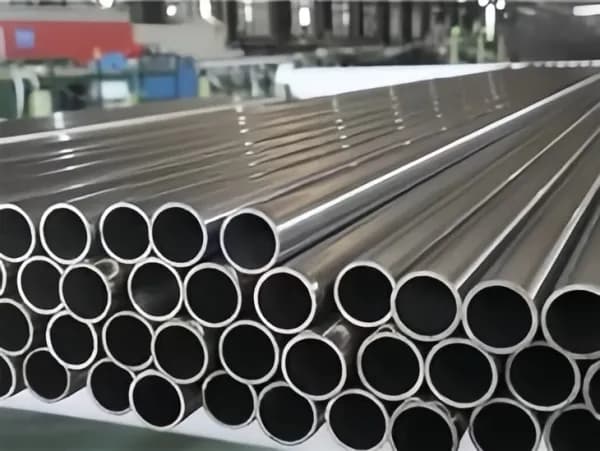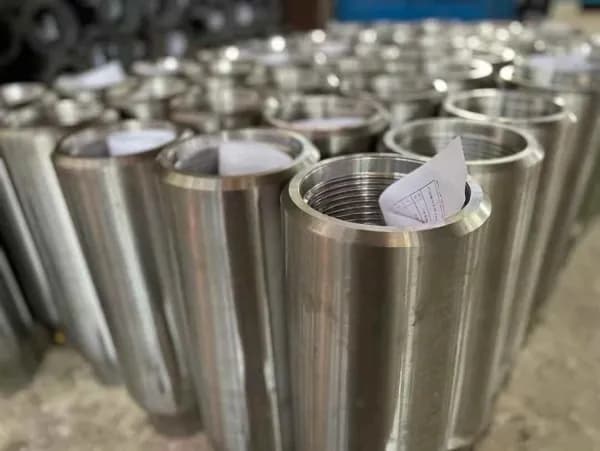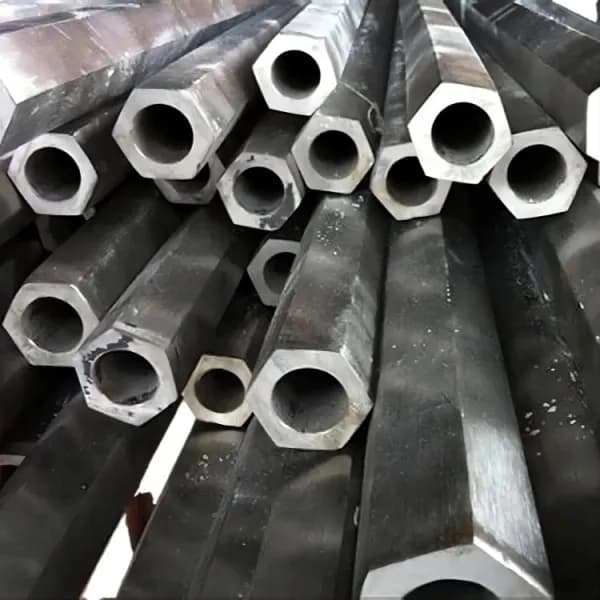
A hexagonal hollow steel pipe is a cold-drawn shaped tube with a six-sided outside profile, normally supplied as a hexagonal outside with either a round bore or a hexagonal bore. It is produced by pulling a round mother tube through a hexagonal die, so the six flats, the corner radii and the wall thickness are set by the die instead of by milling. This page covers the carbon steel hexagonal hollow section we quote to GB/T 3094-2012, the cold-drawn shaped-tube standard that defines the hexagonal profile as class D-5 and tabulates its dimensions and theoretical weight.
The real value of the hexagonal form is not extra strength for the same weight - it is the six flat faces. They give a positive, non-slip fit for a spanner, socket or mating hexagon, they let a tube sit flat and be clamped without rolling, and they make a matched pair of sizes telescope while still transmitting torque. Tell us the across-flats size, the bore form, the steel grade and the delivery condition, and we will quote the section you actually need rather than the nearest standard size.
What a Hexagonal Hollow Steel Pipe Is
A hexagonal hollow section is one of the simple shaped profiles produced by drawing a round tube through a shaped die. Three configurations are common in the market, and they are ordered for different reasons:
- Hexagonal outside, round bore - the flats carry the wrench, clamp or mounting load while the round bore takes a shaft, a bolt or a pilot. This is the usual choice when the outside has to be gripped.
- Hexagonal outside, hexagonal bore - a constant wall around the profile, used where the inside must also accept a hexagonal part, typically as one half of a telescoping pair.
- Round outside, hexagonal bore - used when the tube has to slide or rotate inside a round housing while the inner member is keyed in six positions.
Because the profile is drawn rather than machined, the hexagon is dimensionally repeatable along the full length, which is what makes a sliding hex fit possible in the first place. The section is normally designated by its across-flats size - the distance between two opposite flats - or, on drawings that follow the shaped-tube standard, by its side length. The two are linked by a fixed ratio: across-flats = 1.732 x side length, so a 32 mm across-flats hexagon has an 18.5 mm side. State which basis your drawing uses, because the same number read on the wrong basis is a 15 per cent size error.
One boundary is worth stating up front. A hexagonal structural tube is not a pressure pipe: it is not designed, dimensioned or standardised for fluid or gas containment, and no line-pipe or pressure-pipe specification covers it. Where a project needs a pressure rating, specify a pressure pipe; a hexagon belongs in frames, joints, shafts and architectural work.
Hexagonal versus Round Tube: What the Shape Really Does
The table compares the two shapes on the points that decide a purchase. It deliberately uses two different comparison bases, because supplier copy normally mixes them.
| Property | Hexagonal hollow section | Round tube | What it means in the workshop |
|---|---|---|---|
| Outside faces | Six flats | No flats | A wrench, socket or clamp engages positively instead of slipping on a curved surface |
| Torque at the joint | Form fit wherever the mating part is also hexagonal | Relies on friction, a keyway or a welded joint | Sockets, extension bars and telescoping shafts transmit torque without slipping |
| Rolling and stability | Rests on a flat and does not roll | Rolls freely | Safer and quicker to store, stack, cut, weld and assemble |
| Enclosed area at the same nominal size (across-flats D against diameter D) | 0.866 D² | 0.785 D² | The hexagon encloses about 10 per cent more area and reaches 0.577 D at its corners against 0.500 D for the circle |
| Bending and buckling efficiency per unit of metal area | About 90 per cent of a circular section's second moment of area at equal area and equal wall | The highest of the simple closed shapes | A hexagonal tube is not the more weight-efficient shape: at the same weight a round tube is stiffer in bending and resists buckling better |
| Torsional stiffness of the member | Lower than a circular section at equal area | The highest torsional constant of the simple closed shapes | The hexagon's advantage sits in the joint, not in the member |
| Machining after delivery | The hexagon is already formed by the die | A hexagon has to be milled out of round stock | Shaped tube removes a machining operation and the swarf and handling that go with it |
| Tooling and lead time | Needs a hexagonal die, and a dedicated die if the size is not a standard one | Standard tooling | Non-standard across-flats sizes are a tooling item - confirm feasibility and die ownership before ordering |
Two claims appear on almost every page written about this product, and neither survives checking. The first is that a hexagonal tube is "stronger than a round pipe of the same weight". For the same cross-sectional area and wall thickness a thin-walled hexagon carries about 90 per cent of the second moment of area of a circular section and buckles at a lower load, so a same-weight round tube is the stiffer member. What is true is the comparison at the same across-flats size, where the hexagon does enclose about 10 per cent more area than a round tube of the same nominal diameter because its corners stand outside the inscribed circle. Fix the basis before either number is used.
The second claim is that a hexagonal tube "resists twisting better than a round tube". In the member it does not - a closed circular section has the highest torsional constant of the simple shapes. What the hexagon does is transmit torque without slipping when the mating part is also hexagonal, which is precisely why hexagon tube is standard material for sockets, extension bars and telescoping drive shafts. That is a property of the joint rather than of the section, and it is the one worth designing around.
Which Standard Actually Covers a Hexagonal Section
This is the most common source of confusion on shaped tubes and it is worth settling before an order is placed. Two of the standards routinely quoted for structural hollow sections do not cover a hexagonal profile at all, so a page or a drawing that claims them is claiming something an inspector cannot verify.
| Standard | What it covers | Hexagonal section? | What can legitimately be claimed |
|---|---|---|---|
| GB/T 3094-2012, cold-drawn shaped steel tubes | Simple-section cold-drawn shaped tubes; clause 3 assigns class D-5 to hexagonal tubes (hexagonal inside and outside) and Annex A, Table A.5 tabulates their dimensions and theoretical weight | Yes - profile, dimensions and tolerances are defined | The section and its dimensions can be supplied to GB/T 3094-2012 class D-5, including the standard dimension grade and straightness |
| ASTM A500/A500M | Cold-formed welded and seamless carbon steel structural tubing in rounds and in shapes; the scope names round, square, rectangular or special structural tubular shapes | Yes, as a special shape - but the standard tables dimensions only for round, square and rectangular | Grade and mechanical conformance to A500, with the hexagon dimensions agreed in writing. Quote the edition: A500/A500M-23 limits welded and seamless tubing to a periphery of 88 in. [2235 mm] or less and a wall of 1.000 in. [25.4 mm] or less, and earlier editions carried smaller limits |
| ASTM A501/A501M | Black and hot-dip galvanized hot-formed welded and seamless carbon steel structural tubing in square, round, rectangular or special shape; Grade A minimum yield 250 MPa, Grade B minimum yield 345 MPa | Yes, as a special shape - special shape tubing is permitted provided it complies with all the other requirements, but no dimensions are published for it | Grade and general requirements to A501 Grade A or B, with the hexagon dimensions agreed in writing |
| EN 10210-1 / EN 10210-2 | Hot finished structural hollow sections; the dimensional and tolerance part applies to circular, square, rectangular and elliptical forms only | No - a hexagonal form falls outside the scope | Only the steel grade, for example S355J2H, can be aligned to EN 10210-1. The hexagonal section itself cannot be certified to EN 10210-2 |
| EN 10219-1 / EN 10219-2 | Cold formed welded structural hollow sections; the dimensional part covers the same four forms | No | Same as above - grade alignment only |
| ISO 657-14, hot-rolled steel sections | Dimensions and sectional properties of hot-finished circular, square and rectangular hollow sections; superseded by EN 10210-2 | No - and it is the wrong forming route as well | Nothing for a cold-drawn hexagonal tube. Correct the reference if it appears on an old document |
That leaves two workable routes. Order the tube to GB/T 3094-2012, which genuinely defines the hexagonal profile and gives it a dimension set, a straightness grade and an edge-concavity grade. Or order it to ASTM A500 or A501 as a special shape and put every dimension, corner radius, straightness and twist limit on the order as agreed data. What does not work is quoting a European hollow-section standard for a hexagonal section and expecting an inspector to find a tolerance table for it. If a drawing issued in Europe cites EN 10210 while the part is hexagonal, treat the EN reference as a grade call-out and add the profile data explicitly.
Dimensions, Tolerances and Section Geometry
The reference supply for this product and the tolerances that apply to a cold-drawn shaped tube under GB/T 3094-2012 are set out below. The across-flats size, wall thickness and length below are the supply range. A size outside that range is made to the ordered dimensions.
| Item | Reference or requirement | Notes |
|---|---|---|
| Product form | Cold-drawn hexagonal hollow section, hexagonal outside with round or hexagonal bore | Round outside with hexagonal bore is available by agreement |
| Across-flats size | 18-60 mm across flats | Confirm per order. Side length = across-flats / 1.732; state which basis the drawing uses |
| Wall thickness | 1.0-6.0 mm | Measured on the flat, outside the corner radius (GB/T 3094-2012, 7.1). Corners measure thicker than the flats |
| Length | Up to 6 m, random or fixed cut length | Cut ends square to the axis with burrs removed |
| Outside corner radius | R not greater than 2.0S for wall up to 6 mm, 2.5S for wall 6-10 mm and 3.0S for wall over 10 mm | GB/T 3094-2012, Table 3. A drawn hexagon is never sharp-cornered - allow for R in the joint design |
| Straightness | Ordinary grade not more than 3.0 mm/m and 0.3 per cent of total length; higher grade not more than 2.0 mm/m and 0.2 per cent | GB/T 3094-2012, Table 4. The ordinary grade applies unless a grade is named in the contract |
| Edge concavity | 0.20 mm ordinary grade or 0.10 mm higher grade for a side length up to 30 mm | GB/T 3094-2012, Table 2. Measured at least one maximum side length, and not less than 50 mm, from each end |
| Twist | No obvious twist permitted; no numerical twist limit is tabulated for a hexagonal section | GB/T 3094-2012 forbids obvious twist, but its twist-value table applies to square, rectangular and right-trapezoid tubes only. For a sliding hex fit, agree a twist limit in writing |
| Mass per metre (estimate) | Hexagonal bore: 0.0272 x t x (S - t) kg/m. Round bore of diameter d: 0.0068 S² - 0.00617 d² kg/m | t = wall on the flat, S = across-flats, density taken as 7.85 kg/dm³. For estimating only - GB/T 3094-2012 delivers on actual weight unless theoretical weight is agreed |
The wall-thickness point deserves emphasis because it causes rejected deliveries. A cold-drawn hexagonal tube does not have a constant wall: the six corners take the heaviest reduction and finish thicker and harder than the flats, so a micrometer reading taken across a corner and one taken on a flat will not agree. GB/T 3094-2012 resolves this by defining the measurement position - the flat, outside the corner radius - and the same logic applies to any drawing you issue. State where the wall is to be measured, and state whether the corner thickness is also a controlled feature.
Material Grades and Quality Classes
The grades normally quoted for a cold-drawn carbon steel hexagonal tube, and the reason each one is chosen, are listed below. The grade standard controls the chemistry and the mechanical properties; GB/T 3094-2012 controls the shape, the dimensions and the tolerances.
| Grade | Grade standard | Minimum yield strength | Why it is chosen |
|---|---|---|---|
| Q235B | GB/T 700-2006, carbon structural steel | 235 MPa, fixed by the grade designation | The default grade for general frames, guards, railings, furniture and racking where strength is not the limiting factor |
| Q355B | GB/T 1591-2018, high strength low alloy structural steel | 355 MPa for thickness up to 16 mm | Higher-strength frames, supports and machinery, and any part whose section size is fixed by the available space rather than by the load |
| 20# and 45# | GB/T 699, quality carbon structural steel | As tabulated in GB/T 699 for each grade and condition | Where the part is machined after delivery, or where a specific carbon level is needed for a later heat treatment or induction hardening step |
| Other grades | By agreement | Per the grade standard quoted | Alloy and stainless grades are quoted to their own grade standard while the hexagonal profile is still supplied to GB/T 3094-2012 dimensions |
Two grade notes decide whether a quotation matches a drawing. First the Q345 question: GB/T 1591-2018 replaced Q345 with Q355 at the same strength level while raising the guaranteed yield from 345 to 355 MPa. Material ordered as Q355 satisfies an old Q345 call-out, but the reverse is not safe, so check which edition a drawing was prepared to before accepting a substitution. Second the quality class letter: B, C, D and E denote Charpy impact test temperatures of +20, 0, -20 and -40 °C, so a grade that is correct in strength can still be wrong for a cold-store or outdoor installation. Give the full designation, grade plus quality class, on the enquiry.
Manufacturing Route and Delivery Condition
Cold drawing is what makes this product possible and also what limits it. The mother tube, seamless or welded, is pulled through a hexagonal die with or without an internal mandrel, so the across-flats size, the flat width and the corner radius are fixed in a single pass. The surface keeps its as-drawn finish and no milling is needed, which is why a shaped tube costs less than a machined hexagon on any reasonable run length.
The limitation is the corner effect. In a hexagonal die the six corners take the most severe deformation, so they work-harden more than the flats and finish harder, thicker and more brittle, with residual stresses concentrated at the vertices. An as-drawn tube that is subsequently machined, bent, flared, threaded or welded can release those stresses unevenly and crack at a corner. This is a known consequence of the route rather than a defect, and it is managed through the delivery condition:
| Delivery condition | Code | What it does | When to ask for it |
|---|---|---|---|
| Cold drawn, as-drawn | +C | Highest strength and hardness, lowest ductility | Parts used as they arrive, with no welding, bending or heavy machining |
| Stress relieved | +SR | Relieves the stress concentrated at the corners while keeping most of the cold-work strength | Machined shaft and sleeve parts, lightly welded joints and sliding hex fits |
| Soft annealed | +A | Maximum ductility at the lowest hardness | Parts to be bent, flared, expanded or threaded after delivery |
| Normalized | +N | Uniform grain structure with the directionality removed | Welded assemblies and structural parts where the seam and the corners must behave like the parent metal |
GB/T 3094-2012 supplies tubes in the cold-drawn condition as standard and in a heat-treated condition only when it is agreed in the contract, so a delivery condition that is not written on the order will not be applied. Ask for it whenever the tube will be welded or cyclically loaded.
It is also worth asking whether the mother tube is seamless or welded. A welded mother tube leaves a longitudinal seam whose heat-affected zone behaves differently from the parent metal, and GB/T 3094-2012 requires the marking of a cold-drawn welded tube to identify the weld. On a dynamically loaded part, the position of that seam relative to the load direction is worth controlling.
Applications
Hexagonal hollow sections are bought for the flat faces and the form fit rather than for structural efficiency. The uses below follow from that, and each one has a different controlling dimension.
- Tooling and torque joints. Sockets, spanner and extension bars, nut blanks, tool handles and jigs. The flats transmit torque by form fit, so the across-flats tolerance and the corner radius matter more than the wall.
- Telescoping drive shafts. Matched hexagonal outer and inner tubes are the standard construction for power take-off shafts on agricultural machinery, steering columns and telescopic bracing. The hexagon carries the torque while the pair slides lengthwise, so the buying decisions are the across-flats of both tubes, the running clearance between them and the straightness of each piece.
- Machine and equipment frames. Guards, conveyor and rack frames, support posts, guide sleeves and brackets. Six flats are easier to clamp, drill and bolt than a curved surface, and the tube will not roll during fabrication.
- Anti-roll and architectural work. Gate and fence posts, handrails, balustrades, display and furniture frames, lighting structures and screens, where the hexagon is both stable to assemble and visually distinct.
- Automotive, off-road and agricultural assemblies. Shaft sleeves, chassis and suspension brackets, implement frames and coupling spigots.
Two boundaries apply to all of them. A hexagonal structural tube is not a pressure component and should not be specified where fluid or gas containment is required. And where the load path is genuinely structural and the section is free to be round, a circular tube of the same weight is the better engineering choice - the hexagon earns its place through the joint, the mounting or the appearance.
For round and welded tube in the same material family see the Carbon Steel Pipe range; for other profiled sections see Shaped Steel. Where the requirement is a machined mechanical tube rather than a shaped one, see ASTM A519 precision tubes for hydraulic cylinders.
How to Specify a Hexagonal Hollow Steel Pipe on an Enquiry
Ten items decide whether a quotation for a hexagonal hollow section can be confirmed without a second round of questions. Sending them together shortens the loop considerably.
- Across-flats size, or side length, and which of the two the drawing uses.
- Bore form: hexagonal bore, round bore with its diameter, or the matched pair of tubes for a telescoping fit.
- Wall thickness and the measurement basis, plus whether corner thickness is also controlled.
- Length: fixed cut length, random length or total metres, with the tolerance on the cut.
- Grade and quality class, for example Q235B, Q355B or Q355D, and the edition of the grade standard quoted.
- Delivery condition, +C, +SR, +A or +N, and whether the mother tube is seamless or welded.
- Which dimensions have to be certified: across-flats, wall, straightness, edge concavity, twist and corner radius.
- Surface condition and any coating, with the coating specification if corrosion protection is required.
- End condition: square cut, deburred, chamfered or further machined.
- Inspection and documentation: mill test certificate level such as EN 10204 3.1, dimensional report, and any third-party inspection required.
Add one application sentence as well - whether the tube will be welded, bent, threaded or machined after delivery, and whether it is a static frame or a sliding, torque-carrying part. That single sentence is usually what determines the delivery condition.
Common Questions about Hexagonal Hollow Steel Pipe
What is a hexagonal hollow steel pipe used for?
It is used wherever six flat faces earn their place: sockets, spanner and extension bars and tool handles, where the hexagon grips without slipping; matched outer and inner tubes for telescoping drive shafts and steering columns, where the hexagon transmits torque while the pair slides; machine guards, rack and conveyor frames, guide sleeves and brackets; and gate and fence posts, handrails, balustrades and furniture frames, where a hexagon is stable to assemble and visually distinct.
Is a hexagonal tube stronger than a round tube of the same weight?
No. At the same cross-sectional area and wall thickness a thin-walled hexagon has about 90 per cent of the second moment of area of a circular section and reaches a lower buckling load, so a same-weight round tube is the stiffer member. A hexagonal section does enclose about 10 per cent more area than a round tube of the same nominal diameter, but that is a comparison at equal outside size, not at equal weight. Choose a hexagonal tube for the flats, the anti-roll behaviour, the form-fit torque joint or the appearance, not for weight-efficient stiffness.
Which standard covers a hexagonal hollow section?
GB/T 3094-2012 defines it: clause 3 assigns class D-5 to hexagonal tubes and Annex A, Table A.5 gives the dimensions and theoretical weight. ASTM A500/A500M and A501/A501M both admit a hexagonal tube as a "special shape", but neither publishes dimensions for it, so the profile data has to be agreed in writing. EN 10210-2 and EN 10219-2 cover circular, square, rectangular and elliptical forms only, and ISO 657-14 covers circular, square and rectangular hot-finished sections and has been replaced by EN 10210-2. For a hexagonal part, a European hollow-section reference can only be a steel grade call-out.
Why is the wall thicker at the corners than on the flats?
Because the tube is drawn, not machined. In a hexagonal die the six corners take the heaviest deformation, so they work-harden more than the flats and finish thicker, harder and more brittle. GB/T 3094-2012 answers this by defining wall thickness as measured on the flat, outside the corner radius, and the same rule is worth writing into any drawing you issue. If the part is going to be welded, bent or dynamically loaded, specify a stress-relieved (+SR) or annealed (+A) delivery condition rather than the default as-drawn tube.
What information do you need to quote a hexagonal hollow section?
Send the across-flats size or side length and which basis the drawing uses, the bore form, the wall thickness, the length and quantity, the grade and quality class with the standard edition, the delivery condition, the tolerances that have to be certified, the surface or coating requirement, the end condition, and the certificate level or third-party inspection required. Adding one line on the end use - welded, bent, threaded, static or sliding - lets us recommend the right delivery condition instead of simply matching a size.
Compare this item with the Alloy Steel Pipe range, or start from the Steel Pipe category, before fixing size, grade and quantity.