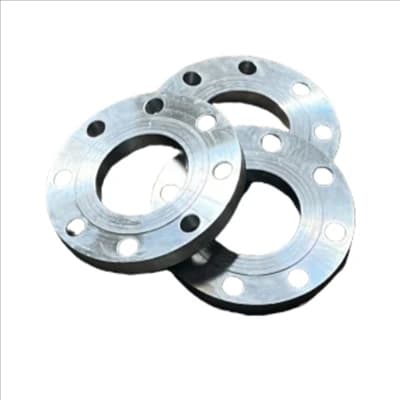
Product Description
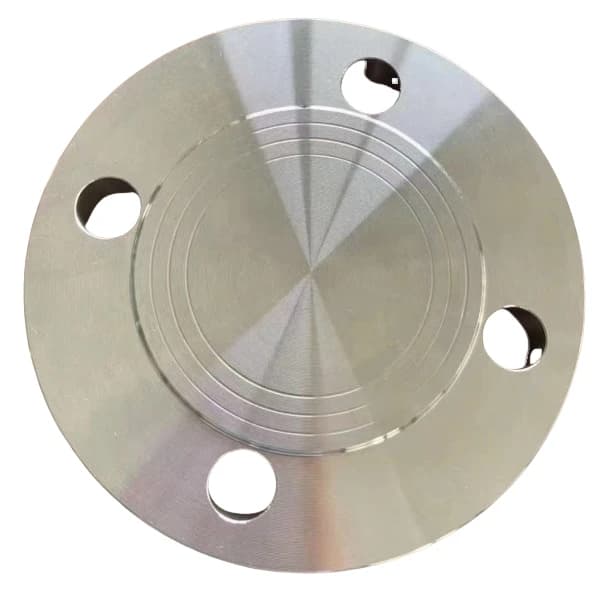
Stainless steel blind flanges are solid, unbored discs bolted against a mating flange to close the end of a piping run, blank off a vessel nozzle outlet, or leave a tagged-in-later extension point on a system that will grow. Because the disc carries no bore, it is the standard choice for terminating a line designed for future tie-ins, isolating equipment during maintenance, and closing test connections. A blind flange seals with a gasket and a bolted joint only — there is no pipe weld on the component itself.
This page covers austenitic stainless steel blind flanges in the forged ASTM A182 grades most often ordered for industrial piping. Blind flanges are one flange type within the wider stainless flange family; weld neck, slip-on and lap joint types each have their own pages and should not be ordered interchangeably with a blind end.
How a Blind Flange Differs from Other Flange Types
A blind flange looks similar to a raised face slip-on or weld neck flange from the bolted side, but the giveaway is the solid face: there is no through-bore for flow. A weld neck flange butts to the pipe with a full-penetration weld and continues the line; a blind flange terminates it. Choosing the wrong type is a common quotation error when drawings only say "flange, Class 300" without the type code, so buyers should confirm the type explicitly. If your line continues past the flange point, you need a weld neck or slip-on type — see our 317 stainless steel weld neck flange page for a typical weld-end configuration. If the line stops, the blind type below is correct.
Standards and Size Ranges
The table below separates the dimensional standards that govern stainless steel blind flanges, because the commonly quoted "1/2 in. to 48 in." range is not the scope of any single standard — ASME B16.5 stops at NPS 24 and large-diameter work changes standard entirely at NPS 26.
| Standard | Coverage for Blind Flanges | Size Range | Pressure Classes |
|---|---|---|---|
| ASME B16.5 | Forged blind flanges, facings RF / FF / RTJ | NPS 1/2 – NPS 24 (DN 15 – 600) | Class 150, 300, 400, 600, 900, 1500, 2500 |
| ASME B16.47 | Large-diameter blind flanges only (with weld necks); Series A (MSS SP-44 legacy) and Series B (API 605 legacy) | NPS 26 – NPS 60 (DN 650 – 1500) | Class 75 (Series B), 150, 300, 400, 600, 900 |
| EN 1092-1 Type 05 | European PN-rated blind flanges; superseded DIN 2527 in 2007 | DN 10 – 1200 per PN series | PN 10 / 16 / 25 / 40 |
Two practical points on this table. First, ASME B16.47 Series A and Series B flanges carry the same class names but different outside diameters and bolt circles — a Series A blind flange will not bolt up to a Series B counterpart, so the series letter must come from the project specification. Second, within EN 1092-1 the dimension series is stepped: sizes up to DN 40 follow the PN 40 table, DN 50 to DN 150 follow PN 16, and larger nominal sizes are standardized at PN 10 and PN 16.
Chemical Composition and Mechanical Properties Basis
Material requirements for forged stainless blind flanges follow the grade specified in the order. ASTM A182 is the forging-material standard for the austenitic grades listed below; each grade carries its own composition limits and minimum mechanical properties in that standard, and the applicable limits depend on the grade and class combination ordered rather than on a single blanket value.
| Attribute | Typical Ordering Basis (reference) |
|---|---|
| Material standard | ASTM A182 (forgings); grade F304, F304L, F316, F316L, F321, F347 |
| European equivalent route | EN 1092-1 Type 05 with material grade per EN designation (e.g. 1.4307 / 1.4571 family) |
| Pressure rating method | Class + material group + temperature per the standard's rating tables; no single MPa value applies |
| Testing and certification | Per the ordered standard edition; specify certificate type on the inquiry |
Class 150 Blind Flange Dimensions
These millimetre values are the Class 150 blind flange dimensions given on this page. Thickness excludes the raised face.
| NPS (DN) | Flange OD (mm) | Flange Thickness (mm, excl. RF) |
|---|---|---|
| 1/2 (15) | 88.9 | 11.2 |
| 3/4 (20) | 98.6 | 12.7 |
| 1 (25) | 108 | 14.2 |
| 1-1/4 (32) | 117.3 | 15.7 |
| 1-1/2 (40) | 127 | 17.5 |
| 2 (50) | 152.4 | 19.1 |
| 2-1/2 (65) | 177.8 | 22.4 |
| 3 (80) | 190.5 | 23.9 |
| 3-1/2 (90) | 215.9 | 23.9 |
| 4 (100) | 228.6 | 23.9 |
| 5 (125) | 254 | 23.9 |
| 6 (150) | 279.4 | 25.4 |
| 8 (200) | 342.9 | 28.4 |
| 10 (250) | 406.4 | 30.2 |
| 12 (300) | 482.6 | 31.8 |
| 14 (350) | 533.4 | 35.1 |
| 16 (400) | 596.9 | 36.6 |
| 18 (450) | 635 | 39.6 |
| 20 (500) | 698.5 | 42.9 |
| 24 (600) | 812.8 | 47.8 |
Material Grade Selection
Grade selection follows the corrosive medium, temperature and the adjoining piping specification rather than a single "best" stainless grade. F304 and F304L are the general-purpose austenitic choices; F316 and F316L add molybdenum for chloride-containing environments; F321 and F347 are stabilized grades for welded construction and elevated-temperature service. Duplex blind flanges such as ASTM A182 F51 and UNS S31803 are a separate product family with their own strength and corrosion profile — see our ASTM A182 F51 duplex blind flange page rather than substituting grades within this page's scope. For forged stainless flanges across other types, our forged stainless flanges and ASME B16.5 stainless steel flanges pages list the type-by-type coverage.
Ordering Information
Each blind flange quotation is priced from the configuration, so include: material grade (or UNS number), NPS/DN size, pressure class, facing type (RF, FF or RTJ), the dimensional standard and edition your specification calls out, and the certificate requirement. For large-diameter orders, state the B16.47 series (A or B) explicitly, because the two series do not interchange. Quantities, special thicknesses and non-listed standards are confirmed per order — sizes, classes and standards on this page describe the ordering framework, not a stock list.
Common Questions about Stainless Steel Blind Flanges
What is a blind flange used for?
It closes the end of a flanged pipe run or a vessel nozzle outlet using a bolted, gasketed joint with no bore for flow. It is also fitted where a line will be extended in the future — the blank end is unbolted and the piping continues from there.
Can I order blind flanges larger than NPS 24?
Yes, but the governing standard changes: ASME B16.5 ends at NPS 24, and blind flanges from NPS 26 through NPS 60 are covered by ASME B16.47 in Series A or Series B. The two series have different bolt circles and are not interchangeable, so specify the series your project uses. A previous version of this page quoted "1/2 in. to 48 in." under B16.5 — that range was incorrect and has been corrected here.
Is DIN 2527 still a valid standard for blind flanges?
DIN 2527 was replaced by EN 1092-1 Type 05 in 2007. Orders can still be matched to drawings originally drawn under DIN 2527, but new specifications should reference EN 1092-1 Type 05, noting that the EN dimension series differs from the old DIN series in the smaller sizes.
Which details are required for a quotation?
Grade, size, pressure class, facing type, dimensional standard (and edition), and certificate requirement. For B16.47 sizes, add the series letter. Ratings are read from the standard's pressure-temperature tables for the ordered material group and temperature, so operating temperature should also be stated.
What dimensions does this page give for a Class 150 blind flange?
The Class 150 table on this page gives the outside diameter and thickness, with the raised face excluded from the thickness. These millimetre values are the dimensions stated on this page.