
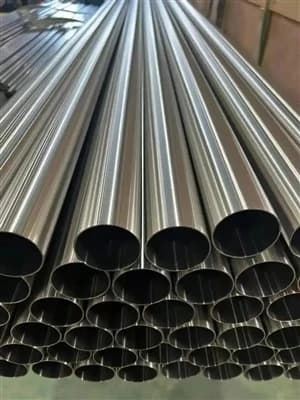
API 5L and ASTM A312 can both appear on an oil and gas project, but they specify different pipe families. API 5L is the line-pipe specification used for pipeline transportation. ASTM A312 covers seamless, welded, and heavily cold-worked austenitic stainless steel pipe for corrosive or elevated-temperature piping. One cannot be substituted for the other by matching outside diameter or schedule.
API 5L and ASTM A312 Have Different Jobs
| Order question | API 5L | ASTM A312 |
|---|---|---|
| Primary product | Carbon steel line pipe for pipeline transportation systems | Austenitic stainless steel pipe for process and pressure piping |
| Typical grade identity | Grade B or an X grade, with PSL stated | TP304L, TP316L, TP321, or another listed stainless grade |
| Manufacturing route | Seamless or an accepted welded process, as ordered | Seamless, welded, or heavily cold-worked, as ordered |
| Key project decision | Line-pipe grade, PSL, route, dimensions, and pipeline supplements | Stainless grade, route, dimensions, heat treatment, and process-service supplements |
The site's carbon steel line pipe scope belongs to the API 5L side. The 316L stainless steel pipe scope belongs to the ASTM A312 side. A project may use both in different systems, but the purchase order must keep the two line items separate.
Start with Service and Design Code
“Oil and gas pipe” is not a product standard. A transmission line, refinery process line, injection line, utility line, and instrument connection can require different materials and design rules. Engineering first identifies the fluid, design pressure and temperature, corrosion environment, installation, and governing code. Procurement then carries those requirements into the material specification without turning a service description into a grade.
Sour service is a supplemental materials question. Neither “API 5L” nor “ASTM A312” alone proves suitability for wet hydrogen sulfide. The order must identify the applicable project requirements, hardness controls, heat-treatment condition, and documentation. Likewise, the word offshore does not automatically select PSL2 or stainless steel.
Write Size as NPS Plus Wall or as OD by Wall
NPS and DN are names, not measured diameters. NPS 2 pipe has an outside diameter of 60.3 mm, NPS 4 is 114.3 mm, and NPS 6 is 168.3 mm in the common ASME pipe dimension system. Schedule changes wall thickness, not outside diameter. State the dimensional standard because stainless schedules with an S suffix and carbon steel schedules without that suffix are not always the same wall.
Do not write only “6 inch pipe.” A complete line identifies NPS 6, the required schedule or wall, the dimensional standard, length, and end preparation. If the project uses measured OD by wall rather than NPS, label both values and do not add a schedule that belongs to another dimensional system.
Choose the Manufacturing Route Explicitly
An API 5L Grade B seamless pipe is one route within the line-pipe family. Electric-welded, longitudinal submerged-arc, and helical submerged-arc products are separate welded routes. A large-diameter straight-seam welded pipe should not be described as seamless, and a spiral product should not be described as LSAW. Write the route that the design accepts.
ASTM A312 also separates seamless and welded construction. Stainless grade and route are independent order fields: TP316L does not mean seamless, and seamless does not mean TP316L. Field welding requirements, corrosion allowance, and examination still come from the project specification.
PSL Is Not a Pressure Class
API 5L PSL1 and PSL2 are product specification levels. PSL2 adds controlled requirements, but it is not a flange class and it does not directly state allowable operating pressure. Pipe pressure design still depends on diameter, wall, material strength, temperature, design factor, weld factor where applicable, corrosion allowance, and the governing pipeline code. Do not compare “PSL2” with “Class 300.”
Use the Certificate to Close the Traceability Loop
- Match purchase order, standard edition, grade, PSL where applicable, route, heat, lot, and dimensions.
- Confirm chemistry and mechanical results are for the ordered heat and product form.
- For welded pipe, confirm the required weld examinations and records are identified.
- Confirm hydrostatic or permitted alternative leak testing is documented as required by the ordered specification.
- Check marking on the pipe against the certificate and packing list before accepting the shipment.
RFQ Fields for Oil and Gas Pipe
| Field | What to write |
|---|---|
| Service and code | Fluid, design pressure, design temperature, location, corrosion conditions, and governing design code |
| Material | API 5L grade and PSL, or ASTM A312 TP grade; do not combine them into one grade |
| Route | Seamless, electric welded, LSAW, SAWH, or the A312 route accepted by the design |
| Dimensions | NPS and schedule with dimensional standard, or OD by wall, plus length and ends |
| Testing | Base-standard tests plus project supplements, witness points, and acceptance criteria |
| Documents | Material certificate, heat traceability, NDT and leak-test records, marking, and packing list |
Questions Buyers Ask
What is API 5L used for in oil and gas? API 5L specifies line pipe used to convey oil, gas and other fluids in pipeline systems.
Where does ASTM A312 fit? ASTM A312 covers seamless, welded and heavily cold-worked austenitic stainless steel pipe for corrosive or elevated-temperature service.
What to Confirm with Your Inquiry
State whether the line item is carbon steel line pipe or stainless process pipe. Then add grade, PSL if applicable, manufacturing route, dimension system, length, ends, service supplements, inspection points, marking, and document package. If the design basis is not fixed, obtain engineering clarification before comparing offers.



