Product Description
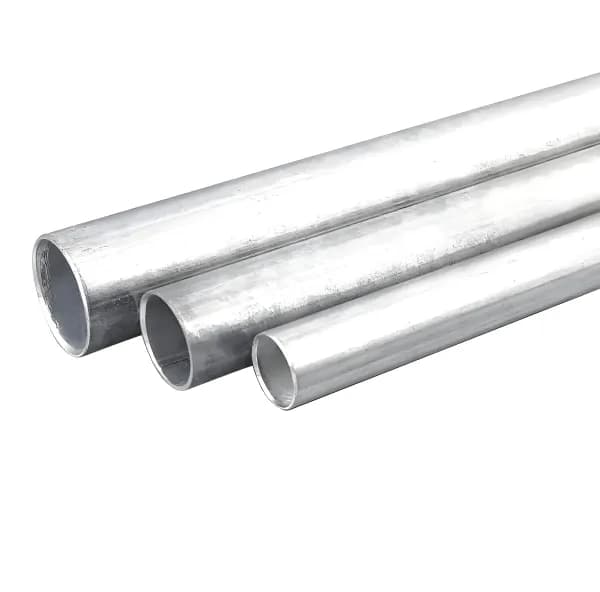
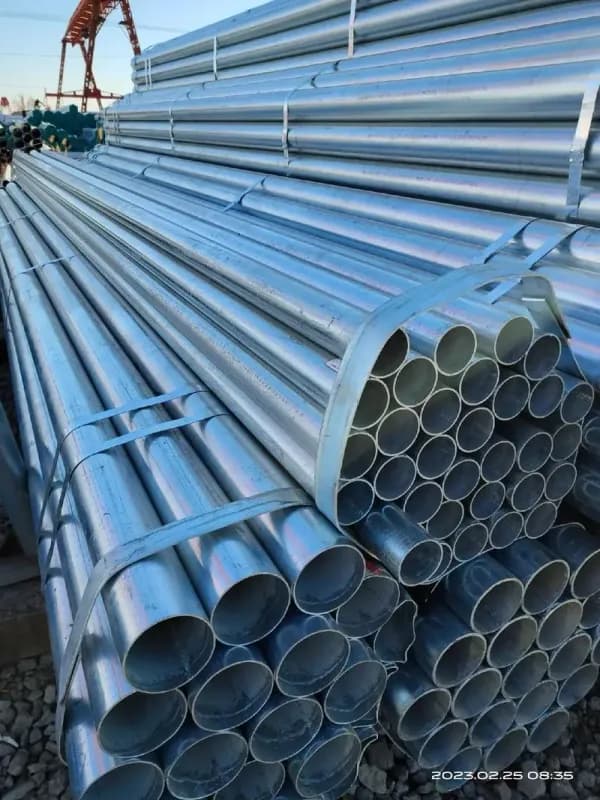
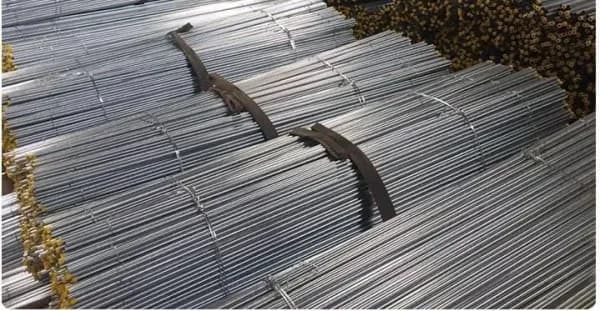
Galvanized electrical conduit is a rigid steel raceway that carries and mechanically protects insulated conductors and cables in an electrical installation. This product is hot-dip galvanized low-carbon steel conduit in the nominal outside diameter series used by the IEC conduit system, with a separate wall series for North American EMT, RMC, and IMC.
Conduit is bought against a document rather than a description, so the specification written on the purchase order decides which product you receive. The IEC and European system splits into IEC 61386-1 (general requirements) and IEC 61386-21 (rigid conduit systems), with outside diameters and threads taken from IEC 60423. North America uses an entirely separate set: UL 6 / ANSI C80.1 for rigid metal conduit, UL 1242 / ANSI C80.6 for intermediate metal conduit and UL 797 / ANSI C80.3 for electrical metallic tubing.
Because the raceway is steel, a properly assembled system of conduit and identified fittings can provide the electrical continuity required of an equipment grounding conductor, and the tube screens the conductors against impact and crushing. Both properties belong to the installed system and to the environment rather than to the tube alone: galvanized steel is not maintenance-free in continuously wet or chemically aggressive service, and the screw threads and cut ends need field-applied protection.
Which Conduit Standard Applies to Your Project
Most quotation errors on galvanized conduit come from naming a standard family without naming the part that covers rigid conduit. Part 1 of every system is the general requirements document; the rigid-conduit requirements sit in part 21.
| Market or system | General requirements | Rigid conduit requirements | Outside diameters and threads | Points to watch |
|---|---|---|---|---|
| International (IEC) | IEC 61386-1 | IEC 61386-21 | IEC 60423 | 61386-21 states that threads and outside diameters shall comply with IEC 60423. Current edition 2021. |
| Europe (CENELEC) | EN 61386-1 | EN 61386-21 | EN 60423 | The EN 61386 series replaced EN 50086 from 2005. Same metric nominal size ladder as IEC 60423. |
| China | GB/T 20041.1 | GB/T 20041.21-2017 | GB/T 20041 series | Modified adoption (MOD) of IEC 61386-21:2002, superseding GB/T 20041.21-2008. A modified adoption is not identical to the IEC text, so do not assume clause-for-clause equivalence. |
| Japan | JIS C 8461-1 | JIS C 8461-21 | JIS C 8461-21 with IEC 60423 | JIS C 8461-21 carries the rigid-conduit requirements; the Japanese product standard for the conduit itself is JIS C 8305 (rigid steel conduits), with JIS C 8330 for metal conduit fittings. |
| United States and Canada | Not split in this way | RMC: UL 6 / ANSI C80.1. IMC: UL 1242 / ANSI C80.6. EMT: UL 797 / ANSI C80.3 | ANSI C80 trade sizes | Three products with three listings, referenced by NEC Articles 344, 342 and 358. Sizes are inch trade sizes, not the IEC metric ladder. |
| Extra heavy duty (IEC) | Outside the 61386 system | IEC 60981:2019 | IEC 60981 | Extra heavy-duty electrical rigid steel (EHDERS) conduits. IEC 60981 states it is not applicable to the conduits specified in IEC 60423, so the two size universes do not overlap. |
Nominal Size, Wall Thickness and Length
IEC-route conduit is ordered by nominal outside diameter on the preferred metric ladder of IEC 60423. It is not ordered by nominal bore and it does not share the nominal sizes of pipe. On the IEC route the wall is the thickness required by the classification digits for that nominal size. It is not one wall for every size.
| Basis | Ordering dimension | What the standards fix, and what they do not |
|---|---|---|
| IEC 60423 metric ladder, nominal outside diameter | 6, 8, 10, 12, 16, 20, 25, 32, 40, 50, 63 and 75 mm | Table 1 covers threadable conduits and their thread details; larger metric thread sizes, for example M90 and M110 to EN 60423, also exist. Wall thickness is not set by this standard - it follows from the mechanical classification the manufacturer declares. |
| North American trade size, ANSI C80.3 (EMT) shown for reference | 1/2, 3/4, 1, 1-1/4, 1-1/2, 2, 2-1/2, 3, 3-1/2 and 4 in | Outside diameters run from 17.93 mm (1/2 in) to 114.30 mm (4 in), with walls from 1.07 mm to 2.11 mm. Trade size is not an outside diameter: 1/2 in EMT measures 0.706 in outside. |
Two warnings attached to that table. The ANSI C80.3 row is the North American EMT size series. EMT, RMC, and IMC walls are the series in the listing named on the order, not the IEC wall. If your specification requires a raceway listed to UL 6, UL 1242 or UL 797, state the listing and the wall thickness you need.
Length follows the programme rather than a fixed figure. North American RMC and EMT are conventionally furnished in nominal 10 ft (3.05 m) lengths and European metric conduit is normally supplied in 3 m lengths; cut lengths, random lengths and long lengths are agreed on the order.
How the IEC 61386 Classification Code Works
IEC 61386-1 requires a conduit system to be classified by declared property instead of by description, and the result is a numeric string in which each position is a tested threshold. IEC 61386-21 requires the conduit to be marked along its length at intervals of preferably 1 m and not more than 3 m, and IEC 61386-1 requires that marking to carry at least the first four digits. Reading the code is the fastest way to compare two galvanized conduits on equal terms, because two tubes that look identical can sit two compression classes apart.
| Position | Property | Values |
|---|---|---|
| 1 | Resistance to compression | 1 very light 125 N; 2 light 320 N; 3 medium 750 N; 4 heavy 1,250 N; 5 very heavy 4,000 N |
| 2 | Resistance to impact | 1 very light 0.5 J; 2 light 1 J; 3 medium 2 J; 4 heavy 6 J; 5 very heavy 20 J |
| 3 | Lower temperature range | 1 +5 °C; 2 -5 °C; 3 -15 °C; 4 -25 °C; 5 -45 °C |
| 4 | Upper temperature range | 1 +60 °C; 2 +90 °C; 3 +105 °C; 4 +120 °C; 5 +150 °C; 6 +250 °C; 7 +400 °C |
| 5 | Resistance to bending | 1 rigid; 2 pliable; 3 pliable and self-recovering; 4 flexible |
| 6 | Electrical characteristics | 0 none declared; 1 continuity; 2 insulating; 3 continuity and insulating |
| 7 | Protection against ingress of solid objects | 3 objects of 2.5 mm and greater; 4 objects of 1.0 mm and greater; 5 dust protected; 6 dust-tight |
| 8 | Protection against ingress of water | 0 none declared; 1 vertical drops; 2 drops up to 15°; 3 spraying water; 4 splashing water; 5 water jets; 6 powerful water jets; 7 temporary immersion |
| 9 | Resistance against corrosion | 1 low, inside and outside; 2 medium, inside and outside; 3 medium inside, high outside; 4 high, inside and outside |
| 10 | Tensile strength | 0 none declared; 1 100 N; 2 250 N; 3 500 N; 4 1,000 N; 5 2,500 N |
| 11 | Resistance to flame propagation | 1 non-flame propagating; 2 flame propagating |
| 12 | Suspended load capacity | 0 none declared; 1 20 N; 2 30 N; 3 150 N; 4 450 N; 5 850 N |
The code is a declaration proved by test, not a marketing grade, so it has to be confirmed for the size you order instead of being inferred from the product name. One related rule is worth knowing: material that propagates flame must be orange, and non-flame-propagating material may be any colour except yellow, orange or red unless it is clearly marked as non-flame propagating. Colour is therefore a statement about fire behaviour, not a quality grade.
Galvanized Coating and Corrosion Resistance
IEC 61386-1 requires metallic conduit systems to resist corrosion inside and outside according to a declared class, and it excludes the screw threads from that requirement - which is why cut threads and cut ends need field-applied protection. The class is proved by a defined test rather than by a coating thickness figure, and hot-dip zinc coating is the example the standard itself gives for the top class.
| Class | Protection declared | Example given in the standard | How the class is checked |
|---|---|---|---|
| 1 | Low, inside and outside | Priming paint | Visual inspection of the coating for completeness, inside and outside |
| 2 | Medium, inside and outside | Stove enamel, electro zinc plate, air-drying paint | Immersion for 5 minutes in a potassium ferricyanide and ammonium persulphate solution: no more than two blue spots per cm² and none larger than 1.5 mm |
| 3 | Medium inside, high outside | Stove enamel | The class 2 test inside combined with the class 4 test outside |
| 4 | High, inside and outside | Hot dip zinc coating, sherardizing, stainless steel | Degrease, pickle in 2 % sulphuric acid, then full immersion in copper sulphate solution of specific gravity 1.186 kg/l at 23 °C: no adherent copper deposit |
Two consequences for a buyer. The class 4 test is a copper sulphate test - the same chemical principle as the Preece test used in North America, where UL 6, UL 1242 and UL 797 accept a zinc coating only if it shows no bright adherent copper deposit after four 60-second immersions. A supplier who answers with a zinc thickness in micrometres instead of a test result is answering a different question. Second, the galvanizing process standard most often quoted for steel tube, EN 10240, is written for tubes in gas and water installations, working scaffolds and structural applications and does not name electrical conduit; ISO 1461 in turn excludes tube galvanized on automatic lines. Neither is the right document to hang a conduit claim on, so this page states the conduit-system route, the IEC 61386-1 corrosion class, instead.
Galvanized steel is not corrosion-proof. The zinc coating protects the steel as a barrier and as a sacrificial anode and it is consumed over time, so service life depends on coating mass and on the environment rather than on a fixed number of years. In continuously wet, chloride-bearing or chemically aggressive service, in buried work, in concrete below grade, or where the conduit will be washed down, supplementary protection is normally specified as well: a zinc-rich or resin coating, a tape wrap or a factory PVC coating, together with protection at cut ends and threads.
Material and Fabrication
The tube is formed from low-carbon steel strip, welded along the seam and galvanized, giving a rigid raceway with a smooth bore. Three details decide how it behaves on site.
- Wall thickness. The wall resists compression and impact and it is the variable that most often differs between two quotations for the same nominal size. Positions 1 and 2 of the classification code, compression and impact, are what your specification is really buying, so ask for them.
- Coating route. Hot-dip galvanizing coats the finished tube inside and outside. Continuous in-line galvanizing of the strip before forming leaves the weld seam and the sheared edges to be protected separately, which is why the process should be stated on the order when the environment is demanding.
- Bore finish. A smooth or internally coated bore is a pulling requirement as much as a corrosion one: it reduces friction on long pulls and limits abrasion of the conductor insulation. Interior treatment belongs on the order, not in your assumptions.
IEC 61386-21 declares whether a conduit is bendable and requires the manufacturer to give the bending instructions and aids; for metallic conduits in sizes 16, 20 and 25 mm the standard's own bending test takes a sample 30 times the nominal diameter and bends it to 90° with an inside radius of six times the nominal diameter, so the coating and the base metal must survive that without visible cracks. Hand bending a rigid galvanized tube instead of using the correct bender kinks the wall and cracks the coating. Threadable sizes take the IEC 60423 thread; North American rigid metal conduit is supplied threaded at both ends with a coupling fitted, while thin-wall EMT is not threaded and uses set-screw or compression fittings.
Applications
Galvanized steel conduit is chosen where a raceway has to survive impact, hold a straight run, remain inspectable and re-wireable, and where a metallic path is wanted for grounding or screening. Typical uses include:
- Commercial and industrial distribution. Exposed power and lighting runs in plant rooms, workshops and warehouses, feeders between distribution boards and machinery, and supply drops and control wiring on production equipment.
- Building services. Horizontal and vertical risers, car parks, plant rooms and service shafts, and wall or ceiling installation where the wall is light and the run has to be protected mechanically.
- Outdoor and infrastructure work. External lighting and yard circuits, loading areas, gate and barrier supplies, and raceway on bridges, tunnels and transport infrastructure.
- Data, communications and fibre. Communications and fibre-optic cabling is inside the scope of the IEC 61386 system, and metal conduit is commonly specified as the protective path for it.
- Agricultural and processing buildings and other wet-service interiors, where washing down and damp conditions rule out an unprotected steel finish.
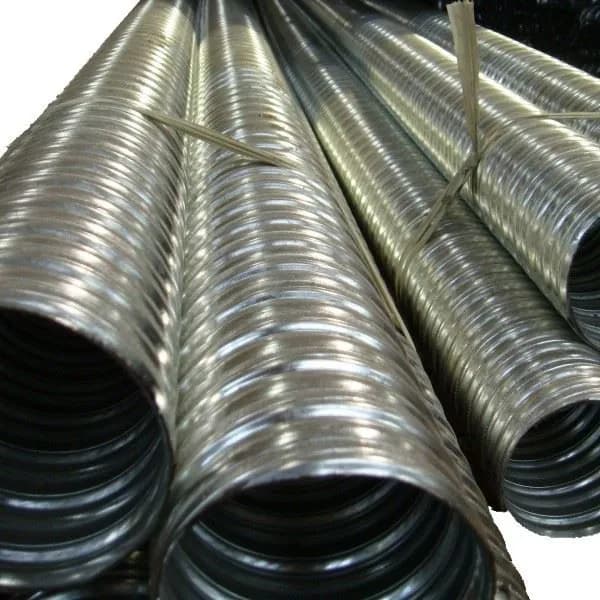
Conduit is not the answer for every route, and the IEC 61386 series is deliberately split to keep the distinctions clear. Where a run has to follow repeated direction changes or move with the equipment, parts 22 and 23 cover pliable and flexible conduit systems. Where the environment is strongly corrosive, a non-metallic or coated system usually wins on lifetime cost. Where the installation is in a classified hazardous area, the article of the electrical code governing that location applies instead of the guidance above. For buried runs, part 24 covers conduit systems buried underground.
Ordering Information
To quote, send the nominal outside diameter or trade size, the wall thickness or the classification digits you need, the length or cut length, the quantity, the finish, the end condition (plain, threaded, or threaded with a coupling), and the governing standard from the table above. Add the service environment, the fittings the run has to match, and the documents required. If the project is in North America, state whether the raceway must be listed to UL 6, UL 1242 or UL 797 and give the trade size, because that requirement changes the wall thickness programme.
Nominal size, length, and finish are stated on the order. Confirm the size list, the classification digits and the document package before placing the order so that the goods and the certificate match the project specification.
Is galvanized electrical conduit the same as galvanized pipe?
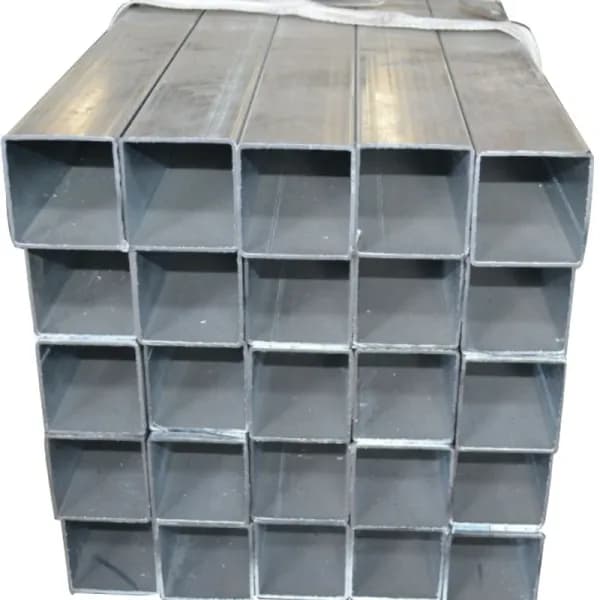
No, and the two are ordered on different bases. Pipe is sized by nominal bore or schedule and carries fluid; conduit is a cable raceway, sized by nominal outside diameter on the IEC ladder or by inch trade size in North America, and it is re-wired rather than used to convey anything. Pipe product standards such as ASTM A53 or EN 10255 do not govern a raceway, so an offer that quotes a pipe standard for conduit is not answering the electrical specification. See the galvanized round pipe, galvanized square tube and Schedule 40 galvanized pipe pages for the fluid and structural programmes.
Which standard should I write on the order?
Name the part that covers the product, not only the family. IEC or European route: IEC 61386-21 (EN 61386-21 in Europe) with IEC 61386-1, plus IEC 60423 if the thread and outside diameter have to be fixed. China: GB/T 20041.21-2017, remembering that it is a modified adoption of the IEC text. Japan: JIS C 8461-21, and JIS C 8305 if rigid steel conduit is specified as such. North America: UL 6 / ANSI C80.1 for RMC, UL 1242 / ANSI C80.6 for IMC and UL 797 / ANSI C80.3 for EMT, where the standard chosen also fixes the wall thickness series and the end finish.
Does hot-dip galvanized or pre-galvanized matter?
It can. Hot-dip galvanizing after forming coats the finished tube inside and outside, including the outside of the weld seam. Continuous in-line galvanizing of the strip coats the flat surface first, so the seam and the sheared edges have a different coating history. Both routes can pass a corrosion test, but the test result is what counts: ask for the result for the class you specify rather than a nominal zinc thickness, and state any coating mass or process standard with the order so it can be certified. Cut ends and threads sit outside the conduit standard corrosion requirement and always need field protection.
What do the IEC 61386 classification digits mean for my project?
They are the compressed specification. Positions 1 and 2 give the compression load and impact energy the tube survives, positions 3 and 4 the installation temperature window, position 5 confirms the conduit is rigid, position 6 states whether the system declares electrical continuity, and position 9 gives the corrosion class. IEC 61386-21 requires the marking along the length at intervals of not more than 3 m with at least the first four digits marked, so the tube carries the declaration and it can be checked against the certificate on delivery.
Can this conduit be threaded, bent or used underground?
Threadable sizes take the IEC 60423 thread and North American rigid conduit is supplied factory threaded with a coupling, but thin-wall EMT is not threaded and uses set-screw or compression fittings. Rigid conduit is bent with a bender to the manufacturer's stated radius; IEC 61386-21 tests metallic conduit in sizes 16, 20 and 25 mm at 30 times the nominal diameter bent to 90° with an inside radius of six times the nominal diameter, so treat that as the order of magnitude rather than a licence to hand-bend. For buried work, part 24 of the IEC 61386 series covers conduits intended to be buried and is a different reference from a general rigid conduit, and buried service normally also calls for supplementary corrosion protection.
What documents should come with the delivery?
The marking on the conduit itself, a mill test certificate for the steel, and the corrosion test result for the class specified. Third-party inspection, a named coating standard or a project-specific test package are added when they are written into the order and not assumed. If the goods must be presented to a consultant or an authority, list the required documents with the enquiry so they can be quoted and produced with the delivery, and check the classification digits against the certificate before the material is installed. The surrounding galvanized water, structural and coated programme is compared on the Galvanized Pipe category page, and composite pipe for water and fire mains is described on the steel-plastic composite pipe page.