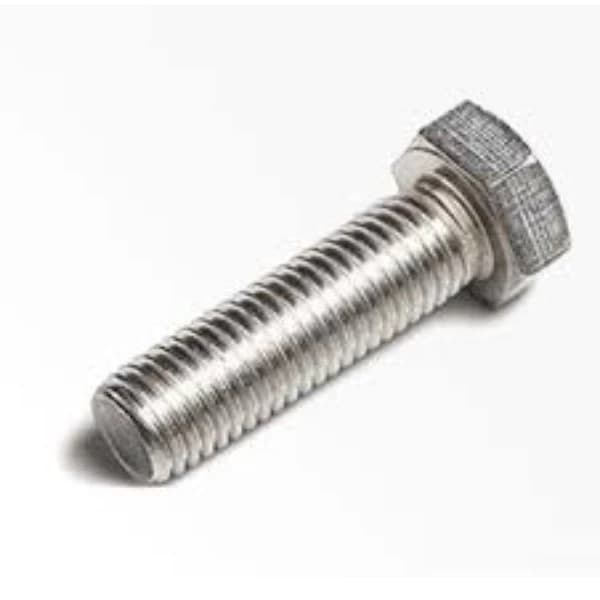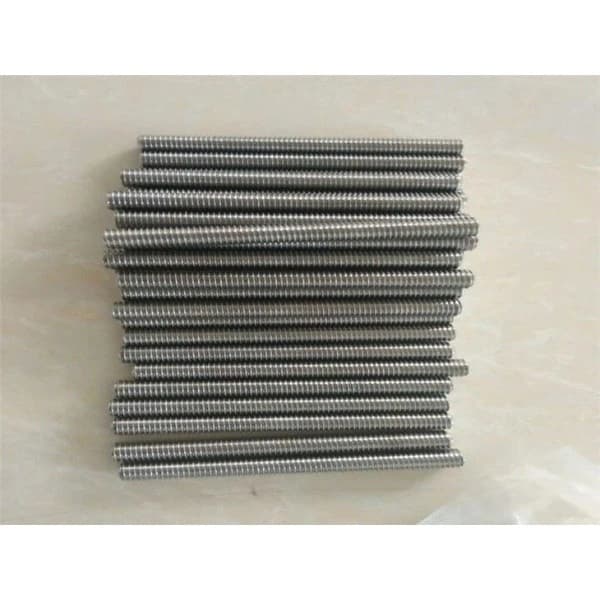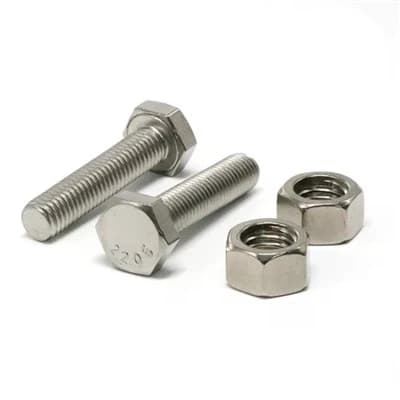
Super Duplex Steel Threaded Rod in our range is fully threaded bar made from UNS S32750 – the 25 % chromium super duplex grade also known as W.Nr 1.4410 and SAF 2507. The PREN calculated from the chromium, molybdenum, and nitrogen window on this page is 37.7 to 47.6, so it is the rod to specify for seawater, brine and high-chloride process media where 316L or 2205 fasteners start to pit or stress-crack. Bar is supplied to ASTM A276 / A479. When the drawing requires duplex pressure bolting, the order names ASTM A1082/A1082M. Threads are ASME B1.1 or DIN 976-1.
Chemical Composition and Mechanical Properties
The composition below follows the ASTM A479 / A276 bar chemistry for UNS S32750. Watch out for supplier compilations that print 0.05 % maximum carbon for this grade – the bar specification limit is 0.030 %, and the tighter figure is the one mill certificates are written against.
| Element | C | Si | Mn | P | S | Cr | Mo | Ni | Cu | N |
|---|---|---|---|---|---|---|---|---|---|---|
| Content (%) | 0.030 max | 0.80 max | 1.20 max | 0.035 max | 0.020 max | 24.0–26.0 | 3.0–5.0 | 6.0–8.0 | 0.50 max | 0.24–0.32 |
Mechanical values are specification minimums for solution-annealed bar. A typical tensile strength of 1000 MPa is a value this page uses. It is not the acceptance minimum. The mill certificate for the heat governs.
| Condition | Tensile strength, min | Yield strength (0.2 % offset), min | Elongation, min |
|---|---|---|---|
| Solution-annealed bar (ASTM A276 / A479) | 800 MPa (116 ksi) | 550 MPa (80 ksi) | 15 % |
Density is 7.8 g/cm³ and the melting range is 1350 °C (2462 °F). Those figures are for gasket and coating selection, not a measure of strength.
Equivalent Designations and Standards Fit
Super duplex rod travels under several names, and the fastest way to spot a wrong-spec quotation is to check which standard each name actually belongs to.
| Designation | Value / Standard |
|---|---|
| UNS | S32750 |
| W.Nr / EN | 1.4410 (X2CrNiMoN25-7-4) |
| Trade name | SAF 2507 / "2507" |
| Bar / rod material | ASTM A276; ASTM A479 (pressure-vessel bar) |
| Forged parts route | ASTM A182 F53 (flanges, fittings – see our Super Duplex S32750 Flanges) |
| Threads, inch | ASME B1.1 UNC / UNF, Class 2A (1A loose / 3A tight on order) |
| Threads, metric | DIN 976-1, tolerance class 6g (ISO 965) |
ASTM A193/A193M covers ferritic and austenitic bolting grades such as B7, B16, B8 and B8M, and its grade table contains no super duplex grade. Threaded rod on this page is A276 / A479 bar with threads added. When the drawing requires duplex pressure bolting, name ASTM A1082/A1082M; that is not an A193 grade and it is not a deviation from a blank line. The A182 F53/F55 designations belong to forged flanges and fittings, and ASTM F593 covers stainless bolt product forms without a super duplex grade either. Naming the right standard on the enquiry is the single cheapest way to avoid re-certification later.
Sizes, Threads and Lengths
The ranges below are the sizes supplied on this page. A size outside them is made to the ordered dimensions.
| Parameter | Supply range |
|---|---|
| Metric diameter | M6 – M52 |
| Inch diameter | 1/4 in – 2 in |
| Standard bar lengths | 1 m and 3 m (DIN 975 convention) |
| Cut lengths | Cut to the ordered length. State chamfer and thread run-out for short pieces. |
| Thread series | UNC coarse / UNF fine per ASME B1.1; metric coarse per DIN 976-1 |
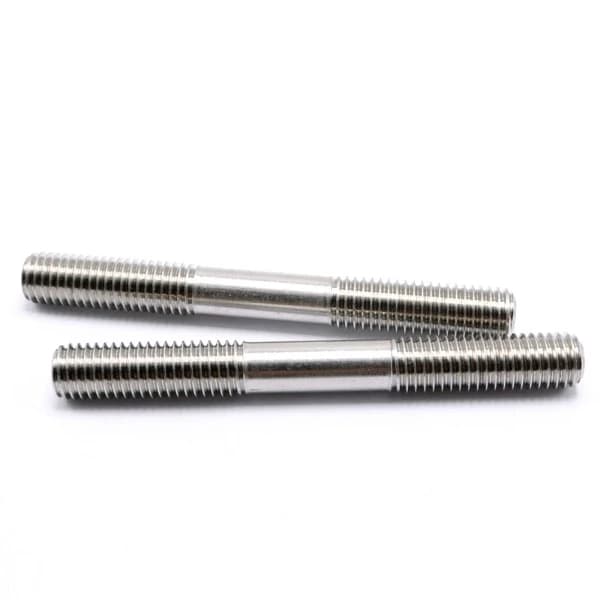
Threaded rod is threaded over its full length, which is what you want for long rigid connections through two nuts. If the joint instead needs a plain grip section in the middle with threads only at the ends, that part is a stud bolt, not rod – our Super Duplex Stud Bolt page covers the double-end form.
Corrosion Resistance and Service Temperature
PREN is calculated as %Cr + 3.3 × %Mo + 16 × %N. The chromium, molybdenum, and nitrogen window on this page computes to 37.7 at the minima and 47.6 at the maxima. The minima sit below the PREN 40 line used to define super duplex, so only a heat toward the top of the window reaches it. Duplex 2205 on the threaded-rod page computes to 30.5 for S31803 and 34.1 for S32205, and that page is the economical choice where the medium is milder.
Long-term service is normally kept below 250-280 °C. Prolonged exposure in the 300-525 °C band embrittles the ferrite (475 °C embrittlement). A higher design temperature is verified against the applicable code. For sour oil and gas service, NACE MR0175 / ISO 15156 does list S32750, but with environment-specific limits on H2S partial pressure, pH, chloride and temperature – acceptance is a project calculation, not a blanket approval.
Surface condition is part of the corrosion case: rod can be supplied pickled, passivated to ASTM A967, or as-machined, and the passivated finish is the usual pick for offshore and marine orders. State the finish on the order so the certificate and the surface treatment match.
How to Order Super Duplex Threaded Rod
A clean enquiry names the five things that decide both price and compliance, and lets the mill certificate do the rest.
- Diameter and thread series (e.g. M20 × 2.5 metric 6g, or 3/4 in-10 UNC Class 2A) and quantity.
- Material standard: A276 for general bar, A479 where the rod feeds pressure-vessel work, or ASTM A1082/A1082M when the drawing requires duplex bolting; ask for the EN 10204 3.1 mill certificate with the shipment.
- Lengths: 1 m or 3 m bars, or cut-to-length with the thread run-out defined.
- Surface: passivated per ASTM A967, pickled, or as-machined.
- Supplementary requirements, if any: NACE MR0175 screening, PMI, impact testing at a stated minimum temperature.
Mating parts are in the same family: browse the full Duplex Steel Fasteners category for nuts and bolts, and if the line also needs S32760 (F55 / 1.4501) hardware, that variant is described on our S32760 Flanges page – keep the two super duplex grades from being mixed on one flange face unless the project allows it.