Product Description
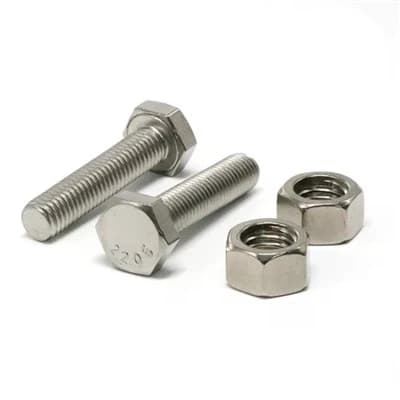
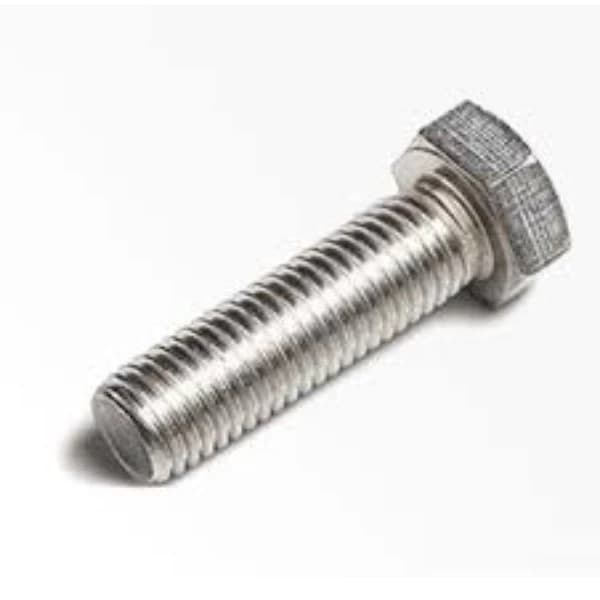
DIN 933 S32750 super duplex bolts are full-thread hexagon head bolts in super duplex stainless steel UNS S32750, also ordered as 2507, EN 1.4410 or X2CrNiMoN25-7-4. DIN 933, now aligned with ISO 4017, fixes the product form: a metric hexagon head and a shank threaded for its full length. It does not set the alloy, the property class or the proof load. The alloy is the reason to choose this bolt for warm chloride service such as seawater, desalination brine and offshore chloride systems, where standard duplex 2205 is often not enough.
S32750 is a ferritic-austenitic grade, not an austenitic stainless steel and not the same alloy as S32760 (Zeron 100, EN 1.4501, F55). The nominal composition table on this page gives 25% chromium, 7% nickel, 4% molybdenum and 0.3% nitrogen. From those nominals, %Cr + 3.3×%Mo + 16×%N is 43. That figure is not a heat analysis, and it does not mean every heat exceeds 41. It is not a certified value for a finished bolt.
What This Bolt Is, and What It Is Not
Three choices have to be written separately on the order, because no single standard covers all three for this alloy.
| Layer | What it decides | What applies here |
|---|---|---|
| Head and thread form | Hexagon head and full-length metric thread | DIN 933 / ISO 4017. A partly threaded shank is DIN 931 / ISO 4014, not this page. |
| Alloy | Which certificate the bar or forging must carry | UNS S32750 (2507, EN 1.4410). Do not substitute S32760, S32205 or S31803. |
| Bolting standard | How the finished bolt is tested and marked | Name it on the order. See the limits below. No property class is implied by the name DIN 933. |
ASTM F593 is the usual standard for general-corrosion stainless bolts, hex cap screws and studs. The active F593-24 store page covers 0.25 to 1.50 in nominal diameter and lists austenitic groups built on 304, 316, 321 and 347. S32750 is not in that list, so an F593 mark cannot be offered on this bolt. ASTM A193/A193M covers alloy-steel and stainless bolting for high-temperature or high-pressure service. The A193/A193M-25 store page, marked Historical and last updated 3 March 2026, describes ferritic and austenitic grades such as B5 and B8. It does not name duplex grades or S32750, so the older claim that these bolts are ASTM A193 Grade B8S is withdrawn. ASTM A1082/A1082M-26, active and last updated 22 July 2026, is the specification written for high-strength precipitation-hardening and duplex stainless bolting. Its public scope does not print the grade table, so S32750 is supplied under it only when the purchase order names that grade and the edition. ASTM A276/A276M and A479/A479M are bar specifications. They can describe the raw material. They are not the acceptance standard for a finished hexagon bolt.
ISO 898-1 is a carbon and alloy steel fastener standard. It does not rate a super duplex bolt, and the old comparison with an ISO 898 property class is withdrawn.
Material Characteristics
The following chemistry is a nominal producer composition for SAF 2507 bar, published for identification. It is not a heat analysis and not a bolt acceptance window. Certified limits come from the edition named on the order.
| Element | Nominal, SAF 2507 bar |
|---|---|
| Carbon | 0.030 max |
| Silicon | 0.8 max |
| Manganese | 1.2 max |
| Phosphorus | 0.035 max |
| Sulfur | 0.015 max |
| Chromium | 25 |
| Nickel | 7 |
| Molybdenum | 4 |
| Nitrogen | 0.3 |
| Copper | 0.5 max |
For pressure bolting ordered to ASTM A1082/A1082M, the minimums already published for S32750 studs on this site are 800 MPa (116 ksi) tensile and 550 MPa (80 ksi) yield at diameters up to 2 in, and 760 MPa (110 ksi) tensile and 515 MPa (75 ksi) yield above 2 in. Those are minimums for that bolting specification and that diameter split, read from the same A1082 table used for the stud bolt. They are not a result for every DIN 933 bolt, and they are not the 795 MPa plate minimum used for S32750 plate. A finished hexagon bolt is certified to the edition named on its order. The ranges previously printed on this page — 800–1000 MPa as if it were one band, yield 550 MPa with no diameter split, elongation 15%, hardness 310 HB or Rockwell C 28–35, and a service range of −50 °C to 300 °C — are withdrawn. Super duplex loses toughness after long exposure in the upper part of that temperature range, but a single pair of temperatures is not a design rating for a bolt.
In the solution-annealed condition the microstructure is a mix of ferrite and austenite, so the bolt is magnetic. That is normal for duplex and is not a sign of the wrong alloy. Cold heading and machining are both used, depending on diameter. Thread fit, whether metric coarse or an inch thread made to a drawing, is confirmed from the order rather than assumed from the DIN 933 name.
Applications
Buyers specify S32750 bolts where a joint sees chlorides and needs more pitting and crevice resistance than 316 or standard duplex 2205. Typical enquiries are seawater and offshore hardware, desalination and brine equipment, and chemical plant handling chloride-bearing process fluids. The alloy is also used for mechanical parts that need the higher strength of duplex steel. Suitability for a named medium, temperature and crevice geometry has to be checked for that service. A pitting test such as ASTM G48 is a laboratory comparison method, not a standing result we attach to every lot.
This page is only the full-thread hexagon bolt. Stud bolts, threaded rod and the broader duplex fastener range are separate products:
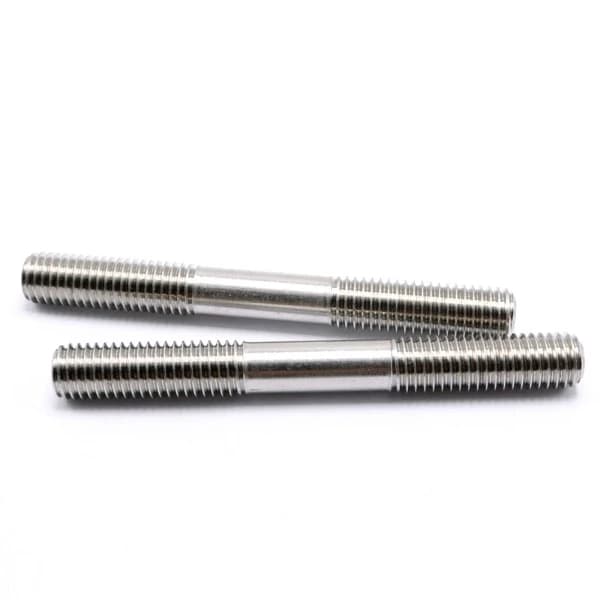
- Super duplex stud bolts for flange bolting that is threaded at both ends.
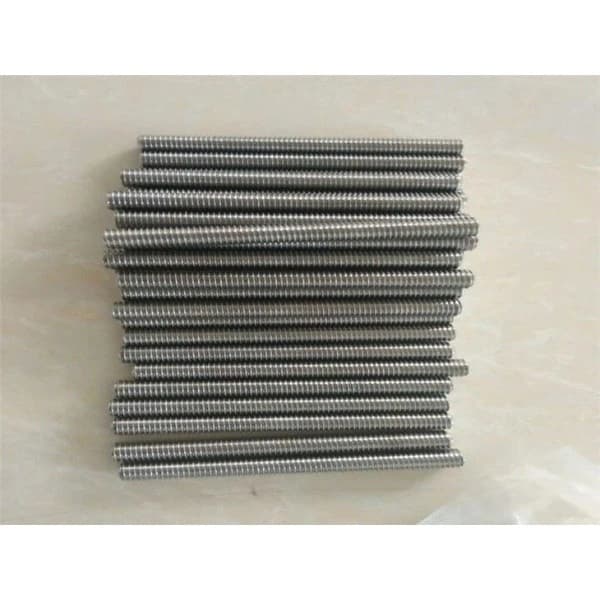
- Super duplex threaded rod when the order is a continuous thread without a hexagon head.
- Duplex stainless steel bolts when the alloy is standard duplex rather than S32750.
- Duplex steel threaded rod for the matching standard-duplex rod.
Ordering Information
A quotation needs the alloy written as UNS S32750, not simply “super duplex”, plus the bolting specification and edition, the diameter and pitch, the length under the head, the quantity, and whether the thread is metric coarse. Add the service (medium, temperature, crevice or gasket details) when corrosion resistance is the reason for the grade, and list the documents required, such as an EN 10204 material certificate. Diameter, length and finish are confirmed per order. Earlier stock ranges on this page, including M6–M64, 1/4–2-1/2 in and lengths to 1000 mm, were not tied to a standard and are not a stock list.
Surface finish is also an order item. Pickling and passivation can be requested. A claimed oxide thickness, a claimed improvement over an untreated bolt, or an oiled storage coating is not a standard supply condition.
Frequently Asked Questions
Are DIN 933 S32750 bolts the same as ASTM A193 Grade B8S?
No. DIN 933 defines a full-thread metric hexagon head. It says nothing about the alloy. The ASTM A193/A193M-25 store page describes ferritic and austenitic bolting grades and does not list S32750, so Grade B8S is not a marking we supply for this bolt. If the joint is pressure-vessel bolting, name ASTM A1082/A1082M and the grade on the order so the covering standard can be confirmed.
What is the difference between S32750 and S32760 bolts?
Both are super duplex, and both are chosen for chloride service, but they are different alloys with different certificates. S32750 is 2507, EN 1.4410. S32760 is the Zeron 100 family, EN 1.4501, and is not supplied against an S32750 order. Standard duplex S32205 and S31803 are a third choice, covered on the duplex bolt page.
Can these bolts be marked A2-70, A4-80 or an ISO 898 class?
No. ISO 3506 property classes such as A2 and A4 apply to the austenitic groups in that standard, and ISO 898-1 applies to carbon and alloy steel fasteners. Neither is an acceptance class for UNS S32750. F593 is also the wrong document: its active alloy list does not include S32750, and it stops at 1.50 in.
What should I send for a quotation?
Send UNS S32750 as the alloy, the bolting standard and edition, diameter, pitch, length, quantity, thread series, and any certificate or corrosion-test requirement. Do not rely on a published tensile strength. The mill certificate for the lot states the tested values against the standard you named.
Why was the 800–1000 MPa range removed?
A single band of 800–1000 MPa is not how ASTM A1082 states the requirement. For S32750 bolting ordered to that specification, the minimums used on the stud-bolt page are 800 MPa tensile and 550 MPa yield up to 2 in, and 760 MPa tensile and 515 MPa yield above 2 in. The mill certificate follows the edition and the diameter on the order.