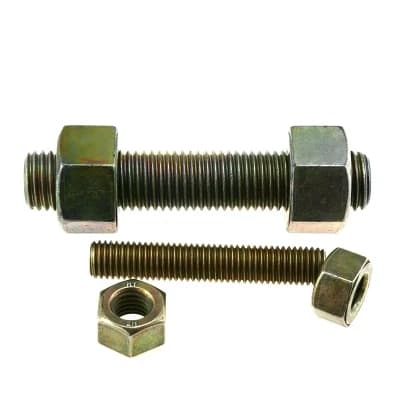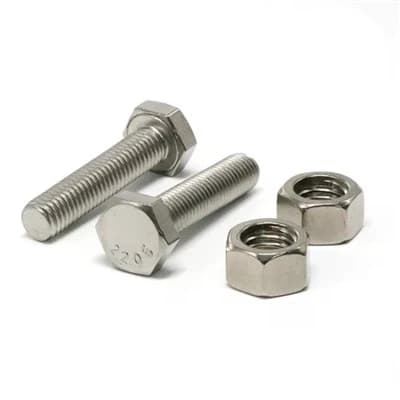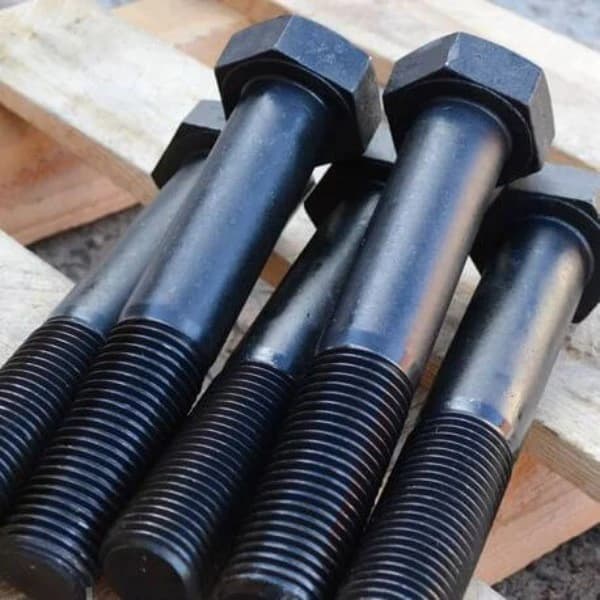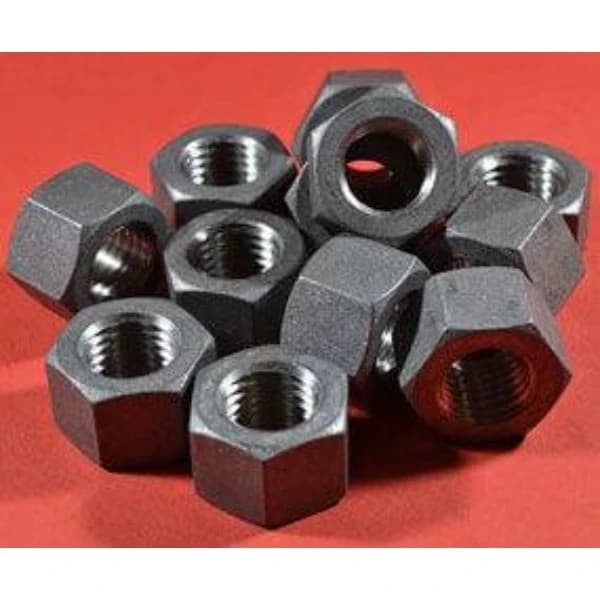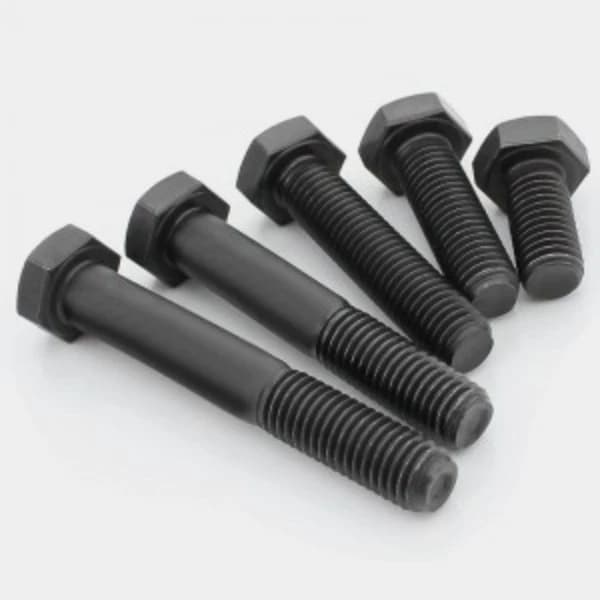
Grade 12.9 Hex Bolts to ISO 898-1
A grade 12.9 hex bolt is the highest property class in common metric use: an alloy steel hexagon head bolt, quenched and tempered through its full section, with a minimum tensile strength of 1,220 MPa. The class is defined by ISO 898-1, the international standard for the mechanical properties of bolts, screws and studs. "12.9 hex bolt" and "grade 12.9 hex bolt" name the same fastener; ISO calls it a property class, North American buyers usually say grade.
The designation is arithmetic, not a marketing grade. The first number multiplied by 100 gives the nominal tensile strength in MPa, so 12 means 1,200 MPa. The digit after the point is the ratio of nominal yield to nominal tensile strength multiplied by ten, so the .9 means the nominal 0.2 percent proof stress is 90 percent of the nominal tensile strength, or 1,080 MPa. Everything else in this class follows from those two numbers: the material has to be alloy steel, it has to be through-hardened, and the finished bolt has to be hard enough and clean enough to reach them without becoming brittle.
That last point is what separates a 12.9 bolt from the rest of the catalogue. Bolts below class 10.9 are bought on strength and price; a 12.9 bolt is bought on strength plus process control, because the same microstructure that delivers 1,220 MPa makes the fastener sensitive to hydrogen and to any heat applied after tempering. This page sets out the property class requirements, the material and heat treatment route, the dimensional standards that give the bolt its head and thread, the coatings that can safely be applied at this strength level, and the checks a buyer can run on an incoming lot.
What the Property Class 12.9 Requires
The values below are the ISO 898-1 requirements for property class 12.9, evaluated at the ambient test range of 10 C to 35 C that the standard applies to all property classes. Nominal and minimum values are listed separately because they are routinely conflated in supplier tables: the nominal figures exist to make the class designation work, while the minimum figures are what a test certificate has to reach.
| Property class | 12.9 to ISO 898-1 |
| Tensile strength, nominal | 1,200 MPa |
| Tensile strength, minimum | 1,220 MPa |
| Stress at 0.2 percent non-proportional elongation, nominal | 1,080 MPa |
| Stress at 0.2 percent non-proportional elongation, minimum | 1,100 MPa |
| Stress under proof load, nominal | 970 MPa, proof strength ratio 0.88 |
| Elongation after fracture, minimum | 8 percent |
| Reduction of area, minimum | 44 percent |
| Hardness | 385 - 435 HV / 380 - 429 HBW / 39 - 44 HRC |
| Surface hardness, maximum | 435 HV 0.3 |
| Material | Alloy steel, quenched and tempered, minimum temper 425 C; or carbon steel with additives (boron, manganese, chromium, or molybdenum), quenched and tempered, minimum temper 380 C |
| Head marking | "12.9" together with the manufacturer's identification mark |
Four details in that table are worth slowing down for, because each one is a common source of a rejected heat or a disputed quotation.
The first is the gap between nominal and minimum tensile strength. A 12.9 bolt is often described as "1,200 MPa", which is the nominal value used by the designation system; the requirement a test specimen actually has to meet is 1,220 MPa. The same split applies to the 0.2 percent proof stress: 1,080 MPa is nominal, 1,100 MPa is the minimum.
The second is the proof load. The nominal stress under proof load for class 12.9 is 970 MPa, not 1,100 MPa. The 1,100 MPa figure that circulates as the "12.9 proof load" is the minimum 0.2 percent proof stress, which is a different quantity measured a different way. The proof strength ratio of 0.88 in the standard is calculated from 970 MPa over the 1,100 MPa minimum.
The third is the hardness window, which is two-sided. A bolt that tests above 435 HV has been over-hardened and is more brittle than the class allows, while a bolt below 385 HV cannot have reached the tensile requirement. Hardness in the middle of the window is the mechanical evidence that the quench and temper cycle was controlled.
The fourth is the diameter scope. The property class table is written for coarse threads from M1.6 to M39 and fine threads from M8x1 to M39x3. Above M39 the designation may still be used, but only if the fastener meets every requirement of the class and the size is agreed between purchaser and manufacturer - so an offer of "12.9 up to M100" is a claim about a manufactured special, not a standard class.
Class 12.9 Against 8.8 and 10.9
The three high-strength classes are quoted almost interchangeably in enquiries, but they are different materials with different ductility and different handling requirements, and they are not interchangeable in a joint. The comparison below uses the ISO 898-1 minimum values, because a joint is designed on minima rather than on the nominal numbers used for the class names.
| Minimum tensile strength | 8.8: 800 MPa; 10.9: 1,040 MPa; 12.9: 1,220 MPa |
| Minimum stress at 0.2 percent non-proportional elongation | 8.8: 640 MPa; 10.9: 940 MPa; 12.9: 1,100 MPa |
| Minimum elongation after fracture | 8.8: 12 percent; 10.9: 9 percent; 12.9: 8 percent |
| Hardness window | 8.8: 250 - 320 HV; 10.9: 320 - 380 HV; 12.9: 385 - 435 HV |
| Material route | 8.8: carbon steel with added elements, or carbon steel, or alloy steel; 10.9: the same three routes; 12.9: alloy steel, minimum temper 425 C; or carbon steel with additives, minimum temper 380 C |
| Hydrogen embrittlement sensitivity | Low at 8.8, high at 10.9, very high at 12.9 |
| Typical duty | 8.8: general engineering and construction; 10.9: automotive and heavy machinery; 12.9: compact high-load joints where a larger bolt will not fit |
Two figures in that table are commonly misquoted. The minimum tensile strength of class 10.9 is 1,040 MPa and its minimum 0.2 percent proof stress is 940 MPa; comparison tables that show 1,000 MPa and 900 MPa for 10.9 are repeating the nominal designation values as if they were requirements. Class 12.9 also has no inch equivalent: SAE Grade 8 is about 150 ksi, roughly 1,034 MPa, which sits below the 12.9 minimum, so an imperial project that needs class 12.9 strength normally has to move to a metric fastener or to a specialty alloy rather than substitute a Grade 8 bolt.
Material and Heat Treatment
Class 12.9 has two routes in the ISO 898-1:2013 transcription used here. One is alloy steel, quenched and tempered, with a minimum tempering temperature of 425 C and carbon 0.30 - 0.50 percent. The other is carbon steel with additives (boron, manganese, chromium, or molybdenum), quenched and tempered, with a minimum tempering temperature of 380 C and carbon 0.28 - 0.50 percent. Class 8.8 and class 10.9 may be made from carbon steel with added elements, plain carbon steel, or alloy steel. The limits below are the alloy-steel route. A supplier cannot simply harden a medium-carbon bolt and stamp it 12.9.
| Carbon (C) | 0.30 - 0.50 percent |
| Phosphorus (P) | 0.025 percent max |
| Sulfur (S) | 0.025 percent max |
| Boron (B) | 0.003 percent max |
| Chromium (Cr) | 0.30 percent min - at least one of the four alloying elements must be present |
| Nickel (Ni) | 0.30 percent min |
| Molybdenum (Mo) | 0.20 percent min |
| Vanadium (V) | 0.10 percent min |
| Minimum tempering temperature, alloy steel route | 425 C |
| Carbon steel with additives, carbon | 0.28 - 0.50 percent |
| Minimum tempering temperature, carbon steel with additives | 380 C |
Three notes travel with that table. When two, three or four of the alloying elements are combined, their total content must be at least 70 percent of the sum of the individual minima - so a steel cannot meet the alloy requirement by carrying traces of several elements that each fall short. The tempering floor is 425 C on the alloy-steel route and 380 C on the carbon-steel-with-additives route. Each floor belongs to its own route: a bolt tempered below the floor for the route ordered will pass a hardness check while failing the ductility requirement. And class 12.9 carries an additional metallurgical restriction: no white phosphide layer detectable by metallography is permitted, and because that layer has to be removed before heat treatment, it cannot be corrected on a finished bolt.
In commercial practice the class is supplied from chromium-molybdenum alloy steels. SCM435 to JIS G4105 is the most widely used, corresponding broadly to 35CrMo and AISI 4135; 42CrMo and 42CrMo4 are used where extra hardenability is needed at the larger diameters of the range. Hardenability falls as diameter rises, so the steel grade is often specified together with the size rather than fixed for the whole range. When a mill certificate is checked against this page, three fields matter: the steel grade and heat number, the tempering temperature against the 425 C floor, and the hardness result against the 385 - 435 HV window - a certificate that shows hardness alone cannot demonstrate that the tempering requirement was met.
Head Form, Thread and Size
ISO 898-1 defines mechanical properties only; it says nothing about the shape of the bolt. Dimensions come from a separate product standard, and the two are normally quoted together on a drawing. For a hexagon head bolt the relevant pair is ISO 4014 and ISO 4017, both written for M1.6 through M64 in product grades A and B.
| ISO 4014 | Hexagon head bolts - a defined unthreaded shank, so the thread is partial where the size and length allow it |
| ISO 4017 | Hexagon head screws - thread along the usable body, the fully threaded counterpart |
| Product grade A or B | A applies to thread diameters up to M24 and lengths up to 10d or 150 mm, whichever is the shorter; B applies beyond those limits. Product grade is a dimensional tolerance class and is not the same thing as the property class |
| Property class coverage | M1.6 to M39 carries the standard property classes, 12.9 among them; above M39, by agreement |
| Thread extents available in 12.9 | Partial thread (ISO 4014) or full thread (ISO 4017), coarse or fine pitch within the scope of the property class table |
| Surface discontinuities | ISO 6157-1 for bolts, screws and studs generally, with the special requirements of ISO 6157-3 applied to property class 12.9 |
| Head marking | Property class and manufacturer's identification mark, per ISO 898-1 |
Two statements in circulation need correcting before they reach a drawing. ISO 4014 is not a heavy hex or structural bolting standard, and it is not the "structural" half of a pair with ISO 4017: the two standards share the same large-series hexagon head across flats, and differ only in how much of the length is threaded. A drawing that needs a defined unthreaded shank across a shear plane is specifying ISO 4014 for that shank, not a heavier head.
The other is the German standard number. DIN 912 - now ISO 4762 - is the hexagon socket head cap screw, a different head form and a different product. Hexagon head bolts are DIN 931 and DIN 933, which are the predecessors of ISO 4014 and ISO 4017. Quoting DIN 912 as the equivalent of a hexagon head bolt is a dimensional error that only surfaces when the parts arrive.
Coatings and Hydrogen Embrittlement
At 1,220 MPa the base metal has no useful atmospheric corrosion resistance of its own, and the coating is where most 12.9 field failures begin: hydrogen picked up in an acid pickle or an electroplating line can migrate to a stressed thread root and cause a delayed brittle fracture hours or days after the joint is tightened. The routes below are the ones normally quoted for a 12.9 hex bolt, with what each one demands.
| As processed | No coating, normally lightly oiled. For protected indoor machinery; the lubricant should still be named if the joint needs a defined friction coefficient |
| Black oxide | A thin conversion coating for appearance and light indoor protection; it is not a barrier coating and is not covered by ISO 10683, which is the zinc flake standard for fasteners |
| Zinc-nickel, electroplated | ASTM B841: Class 1 covers 5 to 12 percent nickel, with minimum thickness Grades 5, 8 and 10 and chromate conversion types A to E. Because it is an electrolytic process, hydrogen embrittlement relief is required at this strength level (ASTM B850 for post-coating treatment, B849 for pre-treatment) |
| Zinc flake | ISO 10683 non-electrolytically applied zinc flake systems. Applied without an electrolytic deposition step and thin enough not to disturb the thread fit, which is why it is the usual first choice for high-strength fasteners |
| Mechanical zinc | ASTM B695. A non-electrolytic alternative where a thicker sacrificial layer is wanted |
| Hot dip galvanizing | ISO 10684. Generally not recommended at class 12.9: the process temperature approaches the tempering range of the bolt and the coating route carries a hydrogen risk. Where a zinc-rich coating is needed, a non-electrolytic system is the safer callout |
Four practical points follow. Relief baking, as shop practice after coating and not as an ISO 898-1 limit, is carried out at 190 - 230 C for several hours and should start as soon as possible after coating, because the hydrogen has to be driven out before the joint is stressed. Acid pickling before coating is restricted at and above class 12.9. A coating should be called out as class, grade and conversion type rather than as a bare thickness range, since "8 - 12 microns" does not match the grade structure of ASTM B841 and leaves the plater to choose. And the coating changes the friction coefficient, so if the joint has a specified preload, the coating and lubricant belong in the same enquiry as the bolt - they decide the torque that will achieve it.
One prohibition belongs with the coatings: a 12.9 bolt must not be welded. Welding heat above the tempering temperature destroys the quenched and tempered condition, and a welded 12.9 bolt is no longer a 12.9 bolt whatever the head still says.
What ISO 898-1 Does Not Cover: Torque, Shear and Temperature
ISO 898-1 states what it specifies and, just as usefully, what it does not: weldability, corrosion resistance, resistance to shear stress, torque and clamp force performance, and fatigue resistance are all outside the standard. The test method for torque and clamp force is a separate document, ISO 16047, and no ISO 898-1 property class value can be quoted as a torque or a shear strength.
That has three consequences for an enquiry. No shear strength can be published for a class 12.9 bolt, so a specification that carries a shear figure such as "920 MPa" is quoting something the standard does not contain - the value that came with the old copy of this page has been removed for that reason, and the shear capacity of a joint should come from the joint calculation, not from a class table. Second, no torque table is a property of the bolt: the tightening torque is derived from the target preload, the thread stress area and the coefficient of friction of the actual coating and lubricant, so the same bolt needs different torque dry and lubricated, and a table without a stated friction condition cannot be used as purchased. Third, the mechanical values are evaluated at 10 C to 35 C. The standard notes that fasteners may not retain them at elevated or low temperatures, and its annex on the subject is informative only - approximate strength reduction at higher temperature, not an acceptance requirement. A performance promise of "works up to 300 C" is reading that annex as if it were a rating.
Checks on an Incoming Lot
Class 12.9 is one of the most counterfeited fastener grades because the class marking is easy to apply and hard to see through. The checks below are the ones that can be run from the delivery documents and a first sample.
Start with the head. ISO 898-1 requires the property class and the manufacturer's identification mark to be permanently marked on the head; heads of M5 and below may carry a clock-face mark instead of digits. A bolt showing the class digits but no manufacturer's mark, or a marking that could have been applied after heat treatment, cannot be accepted as class 12.9 on appearance. Colour and finish prove nothing about class, because the same bolt can be supplied plain, black, zinc flake or zinc-nickel.
Then the mechanical evidence. Hardness in the 385 - 435 HV window, or 39 - 44 HRC, is the fast shop-floor check but it is not sufficient on its own, because a bolt can sit inside the window and still miss the ductility requirement if the tempering was wrong. The reference check is a tensile test on a machined specimen against the 1,220 MPa minimum, with elongation and reduction of area reported alongside it, plus the surface discontinuity inspection required for 12.9 by ISO 6157-3. Ask for the heat number, the steel grade and the tempering temperature on the certificate: those three fields are what turn a hardness reading into evidence that the process was controlled.
Where a 12.9 Hex Bolt Belongs, and Where It Does Not
The class exists to put high load through a small fastener, so it appears where space and weight are limited and the load is not: engine, transmission and suspension joints; heavy machinery such as crushers, presses and excavators; moulds, dies and machine tools; wind turbine and gearbox internal connections; mining and construction equipment.
Two boundaries matter as much as the applications. Preloaded structural steelwork in Europe is covered by the EN 14399 assembly systems, and those systems are built on property classes 8.8 and 10.9 - class 12.9 is not one of the structural bolting classes, so a 12.9 hex bolt is not a substitute for a structural bolting assembly. The imperial equivalents, ASTM A325 at 120 ksi and A490 at 150 ksi, are separate specifications with their own dimensions, threads and markings, and are not metric class 12.9 under another name. Pressure-boundary and piping bolting is normally a stud bolt and nut specification such as A193 with A194 nuts, selected by the applicable piping or pressure equipment code; if a 12.9 bolt is proposed in a code-governed joint, the code has to be checked first, because a property class does not replace a code bolt specification.
Corrosion is the other boundary. The base metal is not corrosion resistant at any class, and at 12.9 the coating options are narrower than at 8.8. Where the environment is the governing design case rather than the load, the material class should change - the stainless and duplex fastener ranges are linked below - rather than the coating alone being upgraded on a high-strength alloy steel bolt.
Ordering Information
An accurate quotation for a 12.9 hex bolt needs the following stated together, because each one changes the price or the process route: the property class and standard, that is 12.9 to ISO 898-1; the dimensional standard and product grade, ISO 4014 or ISO 4017 and grade A or B; nominal diameter, pitch and length, and whether a partial or full thread is required; the steel grade if it is specified, for example SCM435, 35CrMo or 42CrMo; the coating written as class, grade and chromate type, together with the hydrogen embrittlement relief requirement; the friction condition or the required preload where the joint is designed; the matching nut class, which is class 12 to ISO 898-2; the documentation package, normally a mill certificate showing heat number and tempering temperature plus a mechanical test report; and the quantity. Where an elevated service temperature or a corrosive environment is involved, state it with the enquiry - it decides the coating route and whether a different material class should be quoted instead.
Common Questions about Grade 12.9 Hex Bolts
How do I read a 12.9 head marking, and is 1,200 MPa the same as 1,220 MPa?
The head carries the property class "12.9" together with the manufacturer's identification mark, and class and grade mean the same thing - class is the ISO term, grade is the North American one. On the numbers, 1,200 MPa is the nominal value the designation system is built on, while 1,220 MPa is the minimum a tensile test specimen has to reach. The same split applies to the 0.2 percent proof stress, where 1,080 MPa is nominal and 1,100 MPa is the minimum, and to the proof load, where the nominal stress under proof load is 970 MPa.
Can a 12.9 hex bolt be hot dip galvanized?
It is generally not recommended. The galvanizing process applies heat close to the tempering range of a quenched and tempered high-strength bolt and involves an acid preparation step, either of which can put the 1,220 MPa material at risk of hydrogen embrittlement. Where a zinc-rich coating is required, a non-electrolytic route such as a zinc flake system to ISO 10683 or mechanical zinc to ASTM B695 is the safer specification, and an electroplated zinc-nickel to ASTM B841 is acceptable when the hydrogen embrittlement relief treatment is specified and recorded.
Can a 12.9 bolt be used for preloaded structural steelwork?
Not as a structural bolting assembly. The European EN 14399 systems for preloaded structural connections are defined on property classes 8.8 and 10.9, and the North American structural bolts A325 and A490 are separate UNC specifications. A metric 12.9 hex bolt can carry a designed high-strength joint, but it does not fall inside the structural bolting systems, and the connection design has to be checked against the specification the project actually invokes.
What nut should be used with a 12.9 hex bolt?
A nut of property class 12 to ISO 898-2. Nut classes are matched to bolt classes by proof load, and a lower class nut can strip before the bolt reaches its capacity, which turns a high-strength joint into a weaker assembly than the bolt grade suggests. The nut coating should also be matched to the bolt coating so that the friction condition assumed in the joint design stays valid.
What information is needed for a 12.9 hex bolt quotation?
The property class and standard, the dimensional standard and product grade, the diameter, pitch and length with the thread extent, the steel grade if specified, the coating as class, grade and type with the hydrogen embrittlement relief requirement, the nut class if the nut is part of the scope, the service environment and temperature if they are unusual, the documentation package, and the quantity. Stating the dimensional standard and the coating together is what allows the bolt to be quoted as a product rather than as a size.
Related Carbon Steel Fastener Ranges
The other grades in this group answer different enquiries. Mild steel hex bolts and ASTM A307 carbon steel bolts cover the low and medium-strength carbon steel work where class 12.9 would be an unnecessary and less ductile choice; the full range sits under carbon steel fasteners. For pressure and piping bolting, ASTM A193 B7M double-ended studs are the specification normally invoked by the code. Where corrosion rather than load governs the design, the material class changes rather than the coating, and duplex stainless steel bolts are the alternative route.