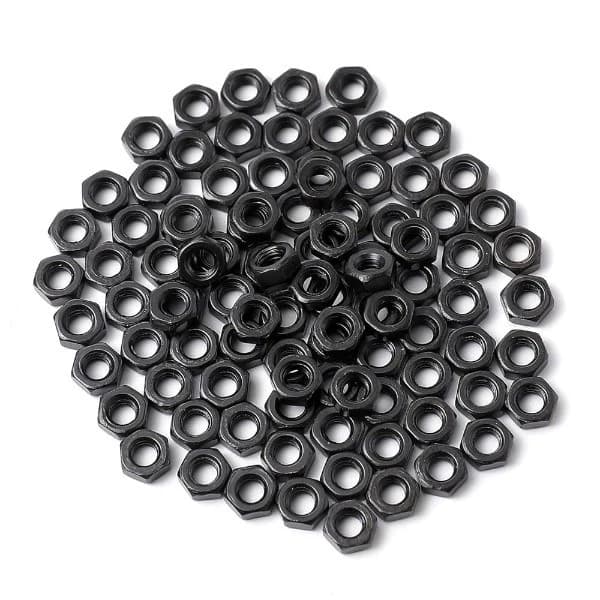
Product Description
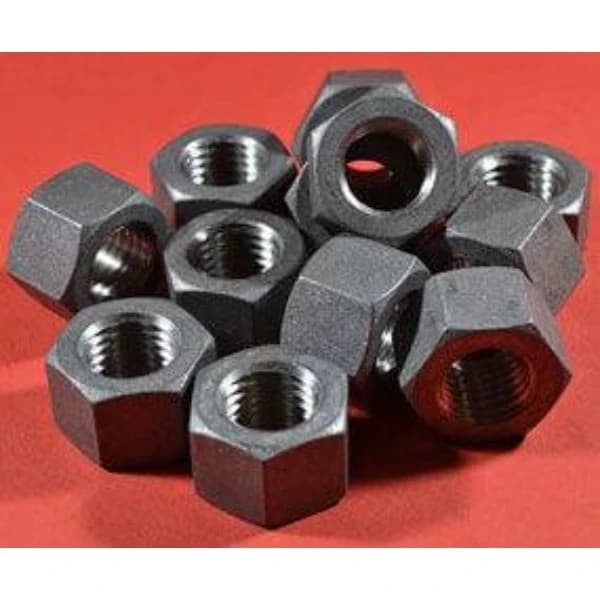
A carbon steel hex nut is a finished six-sided nut. It runs on an externally threaded bolt, stud or screw and is turned with a wrench across the flats. This page covers that finished hex form in carbon steel only. It is not a heavy hex nut, a jam nut, a slotted nut, a nylon-insert lock nut, a flange nut or a coupling nut.
The nut grade is not implied by the words "carbon steel." An inch nut used with a low-carbon bolt is commonly ordered to ASTM A563 with a grade named on the purchase order. Head dimensions, when required, come from the ordered edition of ASME B18.2.2. A metric nut is a different order: ISO 4032 or DIN 934, plus a property class. Those names are ordering paths. They are not a single certificate, and this page does not print proof load or hardness.
An earlier version of this page said the nut was made to ASTM A194, quoted 0.25–0.30% carbon, 550–700 MPa, and a 50-cycle tightening test. That package is withdrawn. ASTM A194/A194M is the specification for carbon, alloy and stainless nuts intended for high-pressure or high-temperature service, or both. A finished carbon steel hex nut is not that part. The same page also pointed metric threads at ISO 898-2 and called low-carbon nuts compliant with ASTM A307. ISO 898-2 is a mechanical-property standard for nuts, not a thread standard. ASTM A307 is a bolt specification; the matching nut discussion stays on the ASTM A307 nut page.
Specifications
The rows below are ordering boundaries, not a stock list and not a proof-load table. Width across flats and thickness belong to the standard edition named on the order. Another seller's inch chart is not copied here.
| Item | How to order |
|---|---|
| Product form | Finished hex nut. Heavy hex, jam, slotted, nylon-insert, flange and coupling nuts are separate parts. |
| Material | Carbon steel. The grade or property class is named on the order. A published carbon or manganese band is not a heat analysis. |
| Inch path | ASTM A563 and a grade, when the drawing requires it. Dimensions from the ordered ASME B18.2.2 edition. |
| Metric path | ISO 4032 or DIN 934, plus the property class, when the drawing is metric. |
| Thread | Name inch or metric, nominal size and pitch. UNC and UNF are not interchangeable. Coarse and fine metric threads are not interchangeable. |
| Finish | Plain, or hot-dip galvanized when specified. Galvanized nuts are tapped to suit the coated bolt. |
Material Characteristics
Carbon steel is the economical nut material when the joint is dry or the coating is specified separately. It is not a corrosion-resistant alloy. Plain nuts are for indoor or dry assembly. Hot-dip galvanizing is a different finish: the coating on the bolt thread is thick enough that the nut is tapped oversize. A plain nut put on a galvanized bolt can seize. Zinc plating, black oxide and a plain oil finish are also different. The old claim that black oxide follows ASTM D769 and passes a 48-hour humidity test is withdrawn. No salt-spray hour, humidity hour or coating thickness is published on this page.
Strength is a nut grade, not a sentence in the product name. The public ASTM store page for A563/A563M-24 is marked Historical. Its abstract says the specification covers chemical and mechanical requirements for hex and hex-flange carbon and alloy steel nuts, and that nuts are tested for hardness and proof load. It does not print the grade table. Because that edition is Historical and the current full text was not available, this page does not publish a proof-load, hardness or chemistry number. ASTM A194/A194M-24 is also marked Historical on the store page. Its scope is high-pressure or high-temperature service, with carbon and alloy grades from 1/4 through 4 in. and M12 through M100, and it does not allow grade substitution without the purchaser's permission. That scope is why A194 is excluded here, not why a tensile number is printed.
ASME B18.2.2 is the inch dimensional standard buyers name for hex, heavy hex and related nut forms. The public ASME site did not return a product page for the current edition during this review, and one supplier chart is explicitly tied to the 1987 edition reaffirmed in 1999. Those dimensions are that seller's table. They are not republished as a supply range. A 3/8-24 plain nut made for a No. 7 threaded taper pin is one SKU under ANSI B18.2.2. Its width, height and UNF pitch belong to that pin nut, not to every carbon steel hex nut.
A small metric nut sold as compatible with GB/T 6170, and described as equivalent to ISO 4032, ASME/ANSI B18.2.4.1M and DIN EN ISO 4032, is a machine-assembly nut. Its "equivalent" line is that seller's statement. It does not make an inch finished hex nut and a metric hex nut the same part.
Applications
Finished carbon steel hex nuts are used where a wrench flat and a reusable thread are enough: machinery covers, equipment frames, light structural bolting and general fabrication. The bolt standard still has to be named. A nut for an ASTM A307 bolt is discussed on the ASTM A307 nut page, and the bolt itself is on the ASTM A307 carbon steel bolt page. A mild-steel hex bolt inquiry starts at the mild steel hex bolt page. The wider group is the carbon steel fasteners range.
Do not use this page for pressure-boundary flanges that call for ASTM A194, for structural joints that call for a heavy hex nut and a structural bolt grade, or for joints that need a prevailing-torque lock nut. Those are different parts. Automotive, marine and piping uses are possible only when the drawing names the nut grade, the coating and the bolt. They are not a default market for a plain carbon steel hex nut.
Ordering Information
Send the thread system, nominal size, pitch, quantity, nut grade or property class, the standard to certify, the finish, and the bolt the nut must run on. If the drawing says heavy hex, say so. If it says ASTM A194, this is the wrong page. Plain and hot-dip galvanized nuts should not be mixed in one line. Documentation follows the order: a catalog page is not a certified material test report.
Availability, delivery time, pricing and replacement terms must be confirmed in the quotation for the specified nut grade, size, finish and quantity.
Questions Before You Order
Is a carbon steel hex nut the same as an ASTM A194 nut?
No. ASTM A194/A194M covers nuts for high-pressure or high-temperature service, or both. A finished carbon steel hex nut is a general fastener. If the drawing says A194, order A194 and name the grade. Do not accept a plain hex nut in its place.
Which standard should I name for a general carbon steel hex nut?
For inch nuts used with low-carbon bolts, buyers commonly name ASTM A563 and a grade, with head dimensions from ASME B18.2.2. For metric nuts, name ISO 4032 or DIN 934 and the property class. This page does not print proof-load or hardness numbers, because the public A563/A563M-24 store page is marked Historical and does not print those tables.
Can this nut replace the ASTM A307 nut on the other page?
No. The ASTM A307 nut page is the companion for an A307 bolt order. This page is the general finished hex nut. Send the bolt standard with the nut inquiry so the two pages are not mixed on one certificate.
Do hot-dip galvanized hex nuts use the same tap as plain nuts?
No. Hot-dip galvanizing adds coating to the bolt thread, so the matching nut is tapped oversize. A plain nut on a galvanized bolt can bind. Name plain or hot-dip galvanized on the order, and do not mix the two in one lot.
What do you need to quote a carbon steel hex nut?
Send thread system, nominal size and pitch, quantity, nut grade or property class, standard, finish, and the bolt it will run on. Heavy hex, jam, slotted and nylon-insert nuts are different parts. Size ranges from another seller's stock list are not a supply range.