
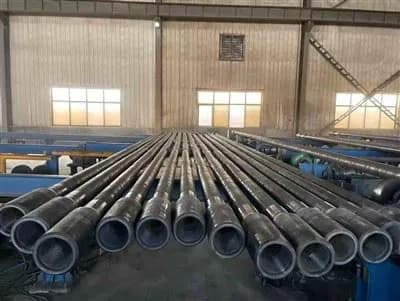
Electric-resistance-welded steel pipe is made by forming flat steel strip into a cylinder and forging the longitudinal edges together with electric-resistance heat. No filler metal is added. It is a welded product, not a seamless pipe, and a grade minimum applies only to the standard, product form and delivery condition named on the order.
The weld is a forged seam, not a filler-metal weld
Coil is trimmed, formed through rolls and closed at a longitudinal seam. High-frequency current heats the edges, and squeeze rolls forge them together. Flash is removed from the inside and outside of the seam. A later heat treatment of the weld zone is used when the pipe specification requires the weld properties to be restored.
That description is the process family. It does not set a line speed, frequency, temperature or length. A brochure figure such as metres per minute, a kilohertz range or a flash temperature is equipment-specific and is not an acceptance value for the pipe you receive.
The useful distinctions are simpler. The seam is longitudinal. The process uses the base metal rather than filler metal. Cold forming can hold outside diameter and wall closely, but the actual tolerance is the one in the named pipe standard, such as ASME B36.10M for carbon and low-alloy steel pipe. Long coil-fed lengths can reduce field joints only when the purchased length is stated.
Name the grade only with its standard
ERW carbon-steel pipe is commonly inquired to ASTM A53, API 5L or ASTM A252, depending on whether the duty is general or pressure service, line pipe, or piling. Each standard has its own grade letter or number, its own product-analysis rules and its own tests. A yield or tensile number from one grade cannot be pasted onto another.
API 5L also separates PSL 1 and PSL 2. PSL 2 is not a cosmetic upgrade. It changes the technical delivery conditions, so the inquiry has to say which level applies. Sour-service additions, including any NACE or ISO hardness requirement, are extra requirements. They are not included merely because the pipe is marked API 5L.
European, Japanese, Chinese and waterworks standards such as EN 10217, JIS G3444, GB/T 3091 and AWWA C200 are different documents. Use one governing standard on the order. Do not stack their grade names on one pipe and expect one certificate to satisfy all of them.
Use the standard that matches the service
General mechanical, water, structural and low- to medium-pressure duties are the usual home of ERW pipe when the design allows a welded seam. Fire-protection systems need the listing or standard the project names, not a general statement that ERW pipe is used for sprinklers. Oil and gas gathering or transmission needs the line-pipe standard, the grade and the product-specification level.
Coating is separate again. Galvanizing, varnish, fusion-bonded epoxy or another coating has to name its own specification and thickness or mass. A galvanized pipe page does not prove that every ERW size is offered with that coating.
Compare ERW with seamless only on the same duty
Seamless pipe has no longitudinal seam. ERW pipe does. Under a code such as ASME B31.3, the weld joint quality factor depends on the weld type and the inspection. Do not publish a single factor as if it applied to every ERW order. If the design needs a higher factor, the specification has to require the examination that earns it.
Size range is also an order item, not a factory slogan. ERW is a coil-formed welded process. Large diameters may instead be longitudinal-submerged-arc or spiral-submerged-arc welded pipe. The existence of another process is not a promise that any of those processes is stocked in a named size.
Fatigue, sour service and high-pressure gas transmission need the project specification. A general article cannot clear ERW pipe for those duties. Hydrostatic testing, ultrasonic or eddy-current examination of the seam, dimensions and visual examination are requested according to the pipe standard and any extra specification. They are not automatically a 100 percent test of every property.
What the inquiry has to contain
- Governing standard, grade and, for API 5L, PSL 1 or PSL 2.
- NPS or outside diameter, schedule or wall, and length.
- Welded ERW as the process, or a different process if that is what the design requires.
- End finish, coating, certificate type and any sour-service or impact test.
- Quantity, inspection and the edition of the standard to be checked.
This site publishes large-diameter straight-seam welded pipe, spiral welded pipe to ASTM A252, A139 and API 5L and stainless steel seamless and welded pipe. Those are the welded and seamless identities to open. They are not a claim that every ERW grade in this article is a stocked product.



