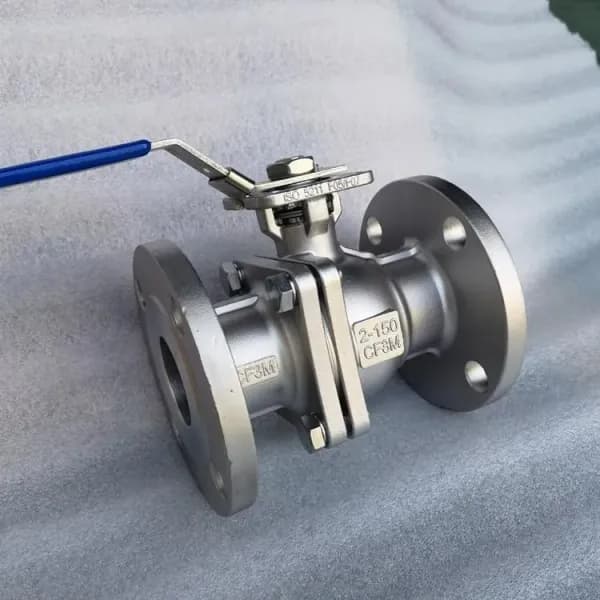
Product Description
A stainless steel ball valve is a quarter-turn shutoff valve. A ball with a hole through it sits between two seats; a 90-degree turn of the stem lines the hole up with the pipe or turns it across the flow. In the open position a full-bore valve gives a straight passage. In the closed position the ball blocks the line. This page covers that shutoff valve in cast stainless steel, not a gate valve, a butterfly valve, or a three-way diverting valve.
Body castings are specified as ASTM A351 CF8, CF8M, CF3 or CF3M, the cast counterparts of 304, 316, 304L and 316L. Wrought bar for a ball or stem is a different product standard, commonly ASTM A276 or A479, and is named on the bill of materials rather than used as the body grade. Duplex 2205 and super duplex 2507 are not stainless grades of the same family. They are quoted only when the order names the duplex casting grade. The older pressure list on this page, which stopped at Class 300 in one place and Class 600 in another, is not a supply range.
How to Specify the Valve
The construction has to be named. A one-piece body is usually a reduced bore and is not taken apart in line. A two-piece body is the common threaded or flanged shutoff. A three-piece body puts the ball and seats in a center section held between two end caps, so that center can be lifted out while the ends stay on the pipe. Three-piece does not mean three-way. A three-way valve has three ports and an L-port or T-port ball, and it is a different item.
Bore and ball support are separate choices. Full bore means the hole through the ball is close to the inside diameter of the connecting pipe, so the pressure drop is small. Reduced bore is smaller than the pipe and is normal on one-piece valves. A floating ball is pushed onto the downstream seat by line pressure and is the usual construction in smaller sizes. A trunnion ball is supported by a top and bottom shaft, which takes the line load off the seats, and is the usual construction once the size or the class makes a floating ball impractical. Neither word implies a size limit on this page.
Standards and What Each One Covers
The standards below are the ones a buyer is asked to name. They are not a claim that every combination on this page is stocked, and they are not interchangeable.
| Topic | Usual standard | What to watch |
|---|---|---|
| Pressure-temperature rating, materials, test and marking for new valves | ASME B16.34 | The class rating is read from the material group and the temperature. It is not one number for every stainless grade. |
| Metal ball valves, flanged, threaded and welding end | API 608 | Written for metal ball valves, generally through Class 600 and NPS 24 for floating-ball designs. It sends the rating back to ASME B16.34. |
| Pipeline ball, gate, plug and check valves | API 6D | A pipeline-valve standard. Name it only for pipeline service. It is not the general industrial ball-valve standard. |
| Face-to-face and end-to-end length | ASME B16.10 | Long pattern and short pattern are different lengths. The drawing has to say which one. |
| Flanged ends | ASME B16.5 | Class 150 and Class 300 flanges do not share a drilling. NPS and DN designations are not always the same number. |
| Butt-welding ends | ASME B16.25 | The weld end has to match the pipe schedule it is welded to. |
| Threaded ends | ASME B1.20.1 | NPT is not BSPP and not BSPT. The thread form belongs on the order. |
| Shell and seat test | API 598 | The test standard is named separately from the design standard. |
| Fire test for a soft-seated quarter-turn valve | API 607 | A fire-test specification, not a design code. Ask for it only when the service requires a fire-tested seat. |
| Cast body | ASTM A351 | CF8, CF8M, CF3 and CF3M. The wrought bar grade is not a substitute for the casting grade. |
Pressure class and PN are not two names for the same rating. Class 150 is not PN16, and a valve built to one system is not assumed to meet the other. If the project uses EN 12516 or an ISO 17292 metal ball valve, that designation replaces API 608 on the order rather than being added beside it.
Body Material
CF8M (cast 316) is the usual body where the fluid carries chlorides or mild corrosives. CF8 (cast 304) is the lower-cost body for water, oil and other services that do not need the molybdenum grade. CF3 and CF3M are the low-carbon castings, used when a weld must keep its corrosion resistance without a post-weld heat treatment. A seat in PTFE is the ordinary soft seat; a metal seat is a different valve and is specified when the temperature or the solids make a soft seat unsuitable. The seat, not the body, is often what sets the temperature limit.
No single pressure or temperature is published here. ASME B16.34 rates each material group by class and temperature, and the allowable pressure falls as the temperature rises. A figure such as 1000 psi, or a temperature such as 1000 °C, describes someone else's catalogue item. It is not a rating for this valve.
Applications
Buyers use this shutoff valve on water treatment, HVAC, light chemical, gas utility, food and pharmaceutical lines, provided the grade, the seat and the end connection match the service. A sanitary clamp end is a different end from an ASME flange and is specified on its own. A flanged valve with an ISO 5211 top pad can take a lever, a gear, a pneumatic actuator or an electric actuator; the actuator is sized from torque, supply air or voltage, and the required failure position, not from the valve size alone.
Do not use a standard round-port ball as a throttling valve. Leaving it partly open puts the seat edge in the flow and wears it. For on/off isolation against a gate valve, the ball valve is the quarter-turn choice and the stainless steel gate valve is the multi-turn choice. Other stainless valve types are listed under stainless steel valves.
Ordering Information
A quotation needs the medium, the operating temperature and pressure, NPS or DN, the pressure class or PN, full or reduced bore, floating or trunnion ball, one-piece, two-piece or three-piece body, the end connection and its standard, the seat, the operator, fire-test or anti-static requirements if they apply, the test and certificate documents, and the quantity. Size and class are confirmed on that enquiry. The old 1 to 24 inch and Class 150 to 2500 statements on this page were catalogue text without a matched construction, and they are not an offer.
Questions Buyers Ask
What information is needed to select a stainless steel ball valve?
Send the medium, temperature and pressure, NPS or DN, pressure class or PN, bore, body style, end connection, seat, operator, and the design and test standards the project requires. The quotation confirms that combination. The material grade on its own does not.
What is the difference between a two-piece and a three-piece ball valve?
A two-piece valve is the usual threaded or flanged shutoff, made in two body sections. A three-piece valve has a center section between two end caps, so the center can come out for cleaning while the ends stay on the pipe. A three-way valve is a different product: it has three ports and an L-port or T-port ball for diverting or mixing.
When is API 608 the right standard, and when is API 6D?
API 608 is the specification for metal ball valves with flanged, threaded and welding ends, and it uses ASME B16.34 for the pressure-temperature rating. API 6D applies to pipeline valves. Use API 6D only when the order is pipeline service. API 607 is a fire test for a soft-seated quarter-turn valve, and it is specified separately when the service needs it.
Does CF8M mean the valve is good for every fluid and every class?
No. CF8M is the cast grade equivalent to 316. CF8 is the cast equivalent of 304. CF3 and CF3M are the low-carbon grades used when the weld has to stay resistant without a post-weld heat treatment. The allowable pressure still comes from the ASME B16.34 rating for that material, class and temperature, and the seat often limits the temperature before the body does.
Should a ball valve be used for throttling?
Use it as a shutoff. A partly open round-port ball leaves the seat edge in the flow and wears the seat. If the duty is modulating, say so on the enquiry so the quotation can offer a valve built for that service instead of a standard shutoff ball.