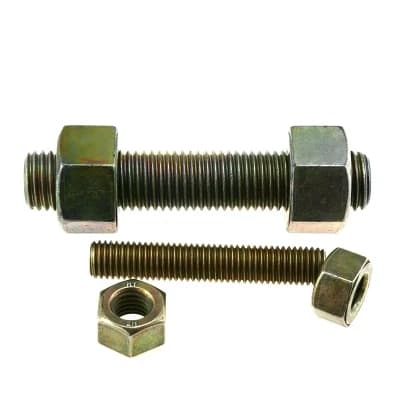
Product Description
ASTM A193 B7M double-ended studs are chromium-molybdenum alloy-steel bolting for pressure vessels, valves, flanges, fittings, and other high-temperature, high-pressure, or special-purpose applications. The B7M designation adds controlled-hardness requirements to the familiar B7 alloy-steel route; it is not a stainless-steel grade and it is not interchangeable with ordinary B7 unless the engineering specification permits the change.
A double-ended stud has threads at both ends and may have a plain shank between them. If the joint instead requires a continuously threaded stud, tap-end stud, or headed bolt, identify that form separately on the drawing or inquiry. ASTM A193/A193M defines the bolting material; thread form, stud geometry, flange joint dimensions, nuts, coating, and service qualification are separate order decisions.
Ordering Specification
The table defines the purchasing framework; dimensions and supplementary requirements remain subject to the drawing and the edition named on the purchase order.
Ordering item | Recommended specification |
|---|---|
Bolting grade | ASTM A193/A193M Grade B7M |
Product form | Double-ended stud; specify thread lengths, plain-shank length, and end configuration |
Material family | Quenched-and-tempered chromium-molybdenum alloy steel |
Hardness control | 235 HBW or 99 HRB maximum is the commonly published B7M limit; acceptance must follow the ordered ASTM edition and test report |
Matching nut | ASTM A194/A194M Grade 2HM is a common pairing when the joint specification calls for it; nut grade is not implied by the stud alone |
Units | State ASTM A193 or A193M. Inch-pound and SI requirements are separate systems and should not be mixed |
Grade and Material Characteristics
B7M is a heat-treated chromium-molybdenum alloy-steel grade with a controlled hardness ceiling. Chemical composition, tensile properties, heat treatment and hardness should be verified against the purchase-order edition of ASTM A193/A193M and the lot-specific material test report.
The letter M in B7M is part of the grade designation; it does not simply mean “metric.” Metric orders should separately name ASTM A193M and the required metric thread standard. Likewise, B7M should not be labeled as W.Nr. 1.4547: that number belongs to a different corrosion-resistant alloy and appears as a supplier-table error in the reviewed references.
Sour-Service and NACE Requirements
Controlled hardness is one reason B7M is considered for H2S-containing service, but the grade name alone does not prove suitability for every sour environment. If compliance with NACE MR0175 / ISO 15156 or NACE MR0103 is required, name the applicable document, edition, environmental limits, hardness requirement, testing, and documentation on the purchase order. Material selection still depends on temperature, H2S partial pressure, chloride level, pH, stress, and the governing equipment or piping code.
Allowable temperature and joint loading depend on the material, diameter, joint standard, design code and service conditions; they are not universal ratings for a B7M stud.
Applications
B7M double-ended studs may be specified for flanged joints and bolted equipment in oil and gas processing, refining, petrochemical, chemical, power, and pressure-equipment projects where controlled-hardness alloy-steel bolting is required. The final selection must come from the project specification; this page does not rate a complete flange joint or guarantee corrosion resistance.
Ordering Information
For a quotation, provide the ASTM A193 or A193M edition, Grade B7M, stud form, nominal diameter, overall length, thread standard and class, thread length at each end, plain-shank diameter and length, quantity, nut and washer requirements, coating, inspection plan, marking, packaging, and required material documentation. For flange joints, also identify NPS, pressure class, facing, gasket, and the governing flange or piping standard so the required stud length can be checked.
If ASTM A194 Grade 2HM nuts are required, state them as a separate line item. Do not substitute 2H for 2HM, or B7 for B7M, without engineering approval.
Frequently Asked Questions
What is the difference between ASTM A193 B7 and B7M?
Both are chromium-molybdenum alloy-steel bolting grades, but B7M uses a controlled-hardness route and additional hardness verification. Order the exact grade shown by the engineering specification; the two grades should not be silently substituted.
Does B7M automatically comply with NACE MR0175 or MR0103?
No. The grade’s hardness control may support a sour-service selection, but compliance depends on the named NACE document, edition, environment, heat treatment, hardness, testing, and documentation. Put those requirements on the purchase order.
Is ASTM A194 Grade 2HM nut included with every B7M stud?
Not automatically. Grade 2HM is a common matching nut for specified B7M assemblies, but the nut grade, quantity, coating, thread fit, and documentation must be ordered separately.
What information is needed to quote a double-ended stud?
Provide diameter, overall length, thread system and class, thread length at both ends, plain-shank dimensions, quantity, ASTM edition, nut and washer grades, coating, inspection, marking, and service requirements.